
|
You entered: constellation
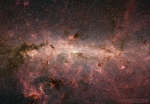 The Galactic Center in Infrared
19.04.2021
What does the center of our galaxy look like? In visible light, the Milky Way's center is hidden by clouds of obscuring dust and gas. But in this stunning vista, the Spitzer Space Telescope's infrared cameras, penetrate much of the dust revealing the stars of the crowded galactic center region.
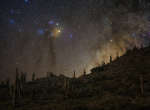 Deepscape at Yacoraite
8.05.2021
In this evocative night scene a dusty central Milky Way rises over the ancient Andean archaeological site of Yacoraite in northwestern Argentina. The denizens of planet Earth reaching skyward are the large Argentine saguaro cactus currently native to the arid region.
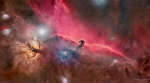 The Horsehead Nebula Region without Stars
29.08.2022
The famous Horsehead Nebula in Orion is not alone. A deep exposure shows that the dark familiar shaped indentation, visible just right of center, is part of a vast complex of absorbing dust and glowing gas.
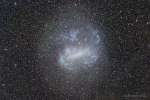 APOD: 2023 March 7 Б Deep Field: The Large Magellanic Cloud
7.03.2023
Is this a spiral galaxy? No. Actually, it is the Large Magellanic Cloud (LMC), the largest satellite galaxy of our own Milky Way Galaxy. The LMC is classified as a dwarf irregular galaxy because of its normally chaotic appearance. In this deep and wide exposure, however, the full extent of the LMC becomes visible.
 Curly Spiral Galaxy M63
19.05.2023
A bright spiral galaxy of the northern sky, Messier 63 is nearby, about 30 million light-years distant toward the loyal constellation Canes Venatici. Also cataloged as NGC 5055, the majestic island universe is nearly 100,000 light-years across, about the size of our own Milky Way.
 APOD: 2023 August 9 Б Meteor Shower: Perseids from Perseus
9.08.2023
This is a good week to see meteors. Comet dust will rain down on planet Earth, streaking through dark skies during peak nights of the annual Perseid Meteor Shower. The featured composite image was taken during the 2018 Perseids from the Poloniny Dark Sky Park in Slovakia.
 M1: The Incredible Expanding Crab
15.11.2023
Cataloged as M1, the Crab Nebula is the first on Charles Messier's famous list of things which are not comets. In fact, the Crab Nebula is now known to be a supernova remnant, an expanding cloud of debris from the death explosion of a massive star.
 M1: The Incredible Expanding Crab
8.05.2025
Cataloged as M1, the Crab Nebula is the first on Charles Messier's famous list of things which are not comets. In fact, the Crab Nebula is now known to be a supernova remnant, an expanding cloud of debris from the death explosion of a massive star.
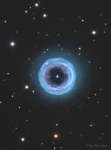 APOD: 2026 March 4 Б Shapley 1: An Annular Planetary Nebula
4.03.2026
WhatБs looking back at you isnБt a cosmic eye, but Shapley 1, a beautifully symmetric planetary nebula. Shapley 1, also known as the Fine Ring Nebula or PLN 329+2.1, bejewels the southern sky constellation of the Carpenter's Square (Norma).
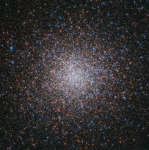 APOD: 2026 May 23 Б Messier 2
23.05.2026
After the Crab Nebula, this giant star cluster is the second entry in 18th century astronomer Charles Messier's famous list of things that are not comets. M2 is one of the largest globular star clusters now known to roam the halo of our Milky Way galaxy.
|
January February March April May June July August September October |
|||||||||||||||||||||||||||||||||||||||||||||||||