
|
You entered: constellation
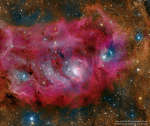 The Lagoon Nebula in High Definition
14.12.2016
Stars are battling gas and dust in the Lagoon Nebula but the photographers are winning. Also known as M8, this photogenic nebula is visible even without binoculars towards the constellation of Sagittarius. The energetic processes of star formation create not only the colors but the chaos.
 Orion over the Austrian Alps
23.01.2019
Do you recognize this constellation? Through the icicles and past the mountains is Orion, one of the most identifiable star groupings on the sky and an icon familiar to humanity for over 30,000 years.
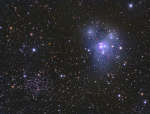 NGC 7129 and NGC 7142
30.08.2019
This wide-field telescopic image looks toward the constellation Cepheus and an intriguing visual pairing of dusty reflection nebula NGC 7129 (right) and open star cluster NGC 7142. The two appear separated by only half a degree on the sky, but they actually lie at quite different distances.
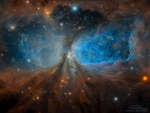 Star Forming Region S106
25.03.2020
Massive star IRS 4 is beginning to spread its wings. Born only about 100,000 years ago, material streaming out from this newborn star has formed the nebula dubbed Sharpless 2-106 Nebula (S106), featured here.
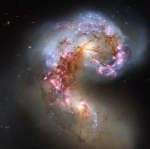 The Antennae Galaxies in Collision
3.12.2020
Sixty million light-years away toward the southerly constellation Corvus, these two large galaxies are colliding. The cosmic train wreck captured in stunning detail in this Hubble Space Telescope snapshot takes hundreds of millions of years to play out. Cataloged as NGC 4038 and NGC 4039, the galaxies' individual stars don't often collide though.
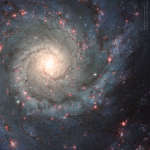 A Perfect Spiral
13.08.2021
If not perfect then this spiral galaxy is at least one of the most photogenic. An island universe of about 100 billion stars, 32 million light-years away toward the constellation Pisces, M74 presents a gorgeous face-on view.
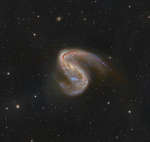 NGC 2442: Galaxy in Volans
29.01.2026
Distorted galaxy NGC 2442 can be found in the southern constellation of the flying fish, (Piscis) Volans. Located about 50 million light-years away, the galaxy's two spiral arms extending from a pronounced central...
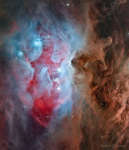 APOD: 2026 February 2 Б Orion: The Running Man Nebula
2.02.2026
What part of Orion is this? Just north of the famous Orion Nebula is a picturesque star forming region in Orion's Sword that contains a lot of intricate dust -- some of which appears blue because it reflects the light of bright embedded stars.
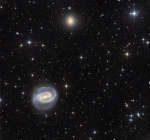 APOD: 2026 March 21 Б Galaxies in the River: NGC 1300 and NGC 1297
21.03.2026
Spiral NGC 1300 and elliptical NGC 1297 are galaxies that lie on the banks of the southern constellation Eridanus (The River). At 70 million light-years distant or more, both are members of the Eridanus Galaxy Cluster.
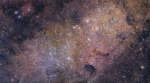 APOD: 2026 July 11 Б Messier 24: Sagittarius Star Cloud
11.07.2026
Unlike most entries in Charles Messier's famous catalog of deep sky objects, M24 is not a bright galaxy, star cluster, or nebula. It's a gap in nearby, obscuring interstellar dust clouds that allows a view of the distant stars in the Sagittarius spiral arm of our Milky Way galaxy.
|
January February March April May June July August September October |
|||||||||||||||||||||||||||||||||||||||||||||||||