
|
You entered: clouds
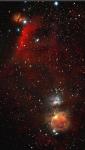 Orion Nebulosities
30.05.2002
Adrift 1,500 light-years away in one of the night sky's most recognizable constellations, the glowing Orion Nebula and the dark Horsehead Nebula are contrasting cosmic vistas. They both appear in this stunning composite color photograph along with other nebulosities as part of the giant Orion Molecular Cloud complex, itself hundreds of light-years across.
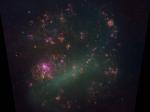 The LMC Galaxy in Glowing Gas
23.01.2006
What goes on inside of a galaxy? To help find out, astronomers from the Magellanic Cloud Emission Line Survey team imaged our neighboring LMC galaxy in spectacular detail and highlighted very specific colors of light emitted by glowing gas.
 The W in Cassiopeia
18.03.2016
A familiar, zigzag, W pattern in northern constellation Cassiopeia is traced by five bright stars in this colorful and broad mosaic. Stretching about 15 degrees across rich starfields, the celestial scene includes dark clouds, bright nebulae, and star clusters along the Milky Way. In yellow-orange hues Cassiopeia's alpha star Shedar is a standout though.
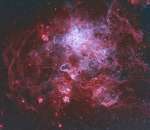 The Tarantula Nebula
16.11.2017
The Tarantula Nebula is more than a thousand light-years in diameter, a giant star forming region within nearby satellite galaxy the Large Magellanic Cloud, about 180 thousand light-years away. The largest, most violent star...
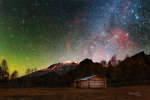 The Gum Nebula over Snowy Mountains
27.06.2022
The Gum Nebula is so large and close it is actually hard to see. This interstellar expanse of glowing hydrogen gas frequently evades notice because it spans 35 degrees -- over 70 full Moons -- while much of it is quite dim.
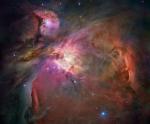 Orion Nebula, The Hubble View
19.01.2006
Few cosmic vistas excite the imagination like the Orion Nebula. Also known as M42, the nebula's glowing gas surrounds hot young stars at the edge of an immense interstellar molecular cloud only 1,500 light-years away.
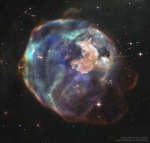 N63A: Supernova Remnant in Visible and X-ray
11.12.2019
What has this supernova left behind? As little as 2,000 years ago, light from a massive stellar explosion in the Large Magellanic Cloud (LMC) first reached planet Earth. The LMC is a close...
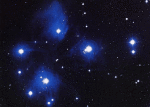 Pleiades Star Cluster
20.06.1995
The Pleiades star cluster, M45, is one of the brightest star clusters visible in the northern hemisphere. It consists of many bright, hot stars that were all formed at the same time within a large cloud of interstellar dust and gas.
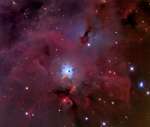 NGC 1999: South of Orion
24.02.2011
South of the large star-forming region known as the Orion Nebula, lies bright blue reflection nebula NGC 1999. Also at the edge of the Orion molecular cloud complex some 1,500 light-years distant, NGC 1999's illumination is provided by the embedded variable star V380 Orionis.
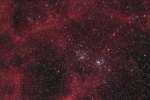 Double Cluster in Perseus
23.01.2014
This lovely starfield spans some seven full moons (about 3.5 degrees) across the heroic northern constellation of Perseus. Just right of center it holds the famous pair of open or galactic star clusters, h and Chi Perseii.
|
January February March April May June July August September October |
|||||||||||||||||||||||||||||||||||||||||||||||||