
|
You entered: clouds
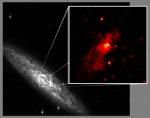 NGC 253: X Ray Zoom
7.06.2001
Astronomers now report that Chandra X-ray Observatory observations of galaxies known to be frantically forming stars show that these galaxies also contain luminous x-ray sources -- thought to be intermediate mass black holes and immense clouds of superheated gas. Take the lovely island universe NGC 253 for example.
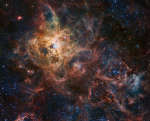 The Tarantula Zone
15.09.2022
The Tarantula Nebula, also known as 30 Doradus, is more than a thousand light-years in diameter, a giant star forming region within nearby satellite galaxy the Large Magellanic Cloud. About 180 thousand light-years away, it's the largest, most violent star forming region known in the whole Local Group of galaxies.
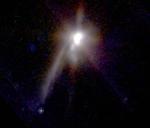 An Extrasolar Planet?
29.05.1998
This infrared Hubble Space Telescope view may contain the first ever direct image of a planet outside our own solar system. The picture shows a very young double star located about 450 light-years away toward the constellation of Taurus.
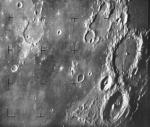 Moon Crashers
15.10.1999
On July 31, 1964, Ranger 7 crashed into the Moon. Seventeen minutes before impact it snapped this picture - the first image of the Moon ever taken by a U.S. spacecraft. Of course Ranger 7 was intended to crash, transmitting close-up pictures of the lunar surface during its final moments.
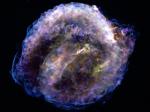 Keplers Supernova Remnant in X Rays
15.01.2007
What caused this mess? Some type of star exploded to create the unusually shaped nebula known as Kepler's supernova remnant, but which type? Light from the stellar explosion that created this energized cosmic cloud was first seen on planet Earth in October 1604, a mere four hundred years ago.
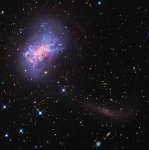 NGC 4449: Star Stream for a Dwarf Galaxy
26.01.2012
A mere 12.5 million light-years from Earth, irregular dwarf galaxy NGC 4449 lies within the confines of Canes Venatici, the constellation of the Hunting Dogs. About the size of our Milky Way's satellite...
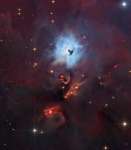 NGC 1999: South of Orion
28.11.2013
South of the large star-forming region known as the Orion Nebula, lies bright blue reflection nebula NGC 1999. At the edge of the Orion molecular cloud complex some 1,500 light-years distant, NGC 1999's illumination is provided by the embedded variable star V380 Orionis.
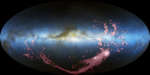 The Magellanic Stream
24.01.2010
Spanning the sky toward the majestic Clouds of Magellan is an unusual stream of gas: the Magellanic Stream. The origin of this gas remains unknown but likely hold a clue to origin and fate of our Milky Way's most famous satellite galaxies: the LMC and the SMC.
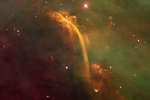 HH 222: The Waterfall Nebula
24.10.2011
What created the Waterfall Nebula? No one knows. The structure seen in the region of NGC 1999 in the Great Orion Molecular Cloud complex is one of the more mysterious structures yet found on the sky. Designated HH-222, the elongated gaseous stream stretches about ten light years and emits an unusual array of colors.
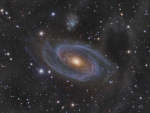 Grand Spiral Galaxy M81 and Arps Loop
16.04.2013
One of the brightest galaxies in planet Earth's sky is similar in size to our Milky Way Galaxy: big, beautiful M81. This grand spiral galaxy lies 11.8 million light-years away toward the northern constellation of the Great Bear (Ursa Major).
|
January February March April May June July August September October |
|||||||||||||||||||||||||||||||||||||||||||||||||