
|
You entered: dark
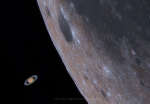 Moon Occults Saturn
9.04.2019
Sometimes Saturn disappears. It doesn't really go away, though, it just disappears from view when our Moon moves in front. Such a Saturnian eclipse was visible along a small swath of Earth -- from Brazil to Sri Lanka -- near the end of last month.
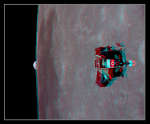 The Eagle Rises
13.07.2019
Get out your red/blue glasses and check out this stereo view from lunar orbit. The 3D anaglyph was created from two photographs (AS11-44-6633, AS11-44-6634) taken by astronaut Michael Collins during the 1969 Apollo 11 mission.
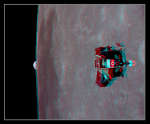 The Eagle Rises
30.07.2022
Get out your red/blue glasses and check out this stereo view from lunar orbit. The 3D anaglyph was created from two photographs (AS11-44-6633, AS11-44-6634) taken by astronaut Michael Collins during the 1969 Apollo 11 mission.
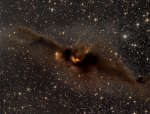 LDN 43: The Cosmic Bat Nebula
31.10.2022
What is the most spook-tacular nebula in the galaxy? One contender is LDN 43, which bears an astonishing resemblance to a vast cosmic bat flying amongst the stars on a dark Halloween night. Located...
 Chamaeleon I Molecular Cloud
27.05.2024
Dark markings and bright nebulae in this telescopic southern sky view are telltale signs of young stars and active star formation. They lie a mere 650 light-years away, at the boundary of the local bubble and the Chamaeleon molecular cloud complex.
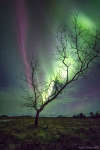 APOD: 2026 March 8 Б The Aurora Tree
8.03.2026
Yes, but can your tree do this? Pictured is a visual coincidence between the dark branches of a nearby tree and bright glow of a distant aurora. The beauty of the aurora -- combined with...
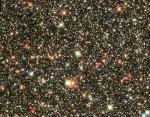 Sagittarius Star Cloud
20.05.2001
Stars come in all different colors. The color of a star indicates its surface temperature, an important property used to assign each star a spectral type. Most stars in the above Sagittarius Star Cloud are orange or red and relatively faint, as our Sun would appear.
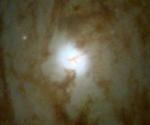 M51: The Center Of The Whirlpool
27.05.2000
In the center of M51, a spiral galaxy 23 million light-years away, astronomers have identified a dense region of young stars. Viewed face-on in the constellation Canes Venatici, the swirling arcs of this galaxy's spiral arms have inspired its popular name, The Whirlpool Galaxy.
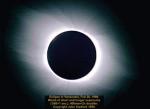 A Total Eclipse of the Sun
11.03.1998
On February 26th, it was dark during the day. This total solar eclipse was the last visible from the Americas for this millennium. A total solar eclipse is exciting partly because it is so short.
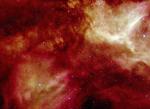 N159 and the Papillon Nebula
21.12.2003
In a search for massive stars, the Hubble Space Telescope has peered into yet another spectacular region of star formation. This nebula, known as N159, spans over 150 light-years and is located in the neighboring Large Magellanic Cloud galaxy, about 170,000 light years distant.
|
January February March April May June July August September |
|||||||||||||||||||||||||||||||||||||||||||||||||