
|
You entered: spacecraft
 Saturn Storm Panoramas
8.07.2011
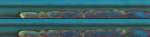
These tantalizing panoramas follow a remarkable giant storm encircling the northern hemisphere of ringed planet Saturn. Still active, the roiling storm clouds were captured in near-infrared images recorded by the Cassini spacecraft on February 26 and stitched into the high resolution, false-color mosaics.
 All of Mercury
12.06.2013
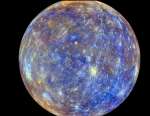
For the first time, the entire surface of planet Mercury has been mapped. Detailed observations of the innermost planet's surprising crust have been ongoing since the robotic MESSENGER spacecraft first passed Mercury in 2008 and began orbiting in 2011.
 Flyby Image of Saturns Sponge Moon Hyperion
3.06.2015
Why does this moon look like a sponge? To better investigate, NASA and ESA sent the Saturn-orbiting robotic spacecraft Cassini zooming past Saturn's moon Hyperion, once again, earlier this week. One of the images beamed back to Earth is featured above, raw and unprocessed.
 Solar System Portrait
11.02.2017
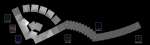
On Valentine's Day in 1990, cruising four billion miles from the Sun, the Voyager 1 spacecraft looked back one last time to make this first ever Solar System family portrait. The complete portrait is a 60 frame mosaic made from a vantage point 32 degrees above the ecliptic plane.
 Solar System Family Portrait
14.02.2019
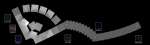
On Valentine's Day in 1990, cruising four billion miles from the Sun, the Voyager 1 spacecraft looked back one last time to make this first ever Solar System family portrait. The complete portrait is a 60 frame mosaic made from a vantage point 32 degrees above the ecliptic plane.
 Enceladus in Infrared
24.09.2020
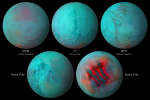
One of our Solar System's most tantalizing worlds, icy Saturnian moon Enceladus appears in these detailed hemisphere views from the Cassini spacecraft. In false color, the five panels present 13 years of infrared image data from Cassini's Visual and Infrared Mapping Spectrometer and Imaging Science Subsystem.
 Northern Pluto
18.08.2023
Gaze across the frozen canyons of northern Pluto in this contrast enhanced color scene. The image data used to construct it was acquired in July 2015 by the New Horizons spacecraft as it made the first reconnaissance flight through the remote Pluto system six billion kilometers from the Sun.
 APOD: 2025 February 12 Б Asteroid Bennu Holds the Building Blocks of Life
12.02.2025
What can a space rock tell us about life on Earth? NASA's OSIRIS-REx spacecraft made a careful approach to the near-Earth asteroid 101955 Bennu in October of 2020 to collect surface samples. In September 2023, the robotic spaceship returned these samples to Earth.
 22 Miles From Eros
3.08.2000
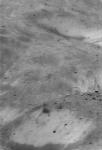
Last month the NEAR Shoemaker spacecraft swooped closer to Eros, orbiting only 22 miles (36 kilometers) from the center of the asteroid. These two images taken on July 19 (left) and July 24 (right)...
 Folding Europa
25.08.2000
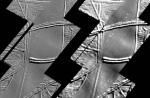
Astypalaea Linea on Jovian ice moon Europa is the broad smooth region running through these images recorded by the Galileo spacecraft in 1998. The pictures are different computer processed versions of the same mosaic -- on the left, small scale details have been enhanced while on the right, large scale features are emphasized.
|
January February March April May June July August September October |
|||||||||||||||||||||||||||||||||||||||||||||||||