
|
You entered: spacecraft
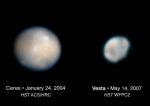 Small Worlds Ceres and Vesta
22.06.2007
Ceres and Vesta are, respectively, only around 950 kilometers and 530 kilometers in diameter - about the size of Texas and Arizona. But they are two of the largest of over 100,000 minor bodies orbiting in the main asteroid belt between Mars and Jupiter.
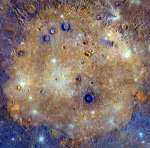 Enhanced Color Caloris
4.03.2015
The sprawling Caloris basin on Mercury is one of the solar system's largest impact basins, created during the early history of the solar system by the impact of a large asteroid-sized body.
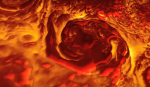 Flyover of Jupiters North Pole in Infrared
16.04.2018
What would it look like to fly over the North Pole of Jupiter? A fictional animation made from real images and data captured by NASA's Juno spacecraft shows an answer. Since the pole...
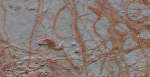 The Surface of Europa
19.05.2016
An enhanced-color view, this image covers a 350 by 750 kilometer swath across the surface of Jupiter's tantalizing moon Europa. The close-up combines high-resolution image data with lower resolution color data from observations made in 1998 by the Galileo spacecraft.
 Moons of Saturn
17.10.2019
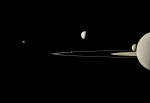
On July 29, 2011 the Cassini spacecraft's narrow-angle camera took this snapshot and captured 5 of Saturn's moons, from just above the ringplane. Left to right are small moons Janus and Pandora respectively 179 and 81 kilometers across, shiny 504 kilometer diameter Enceladus, and Mimas, 396 kilometers across, seen just next to Rhea.
 APOD: 2020 September 2 Б Jupiter and the Moons
2.09.2020
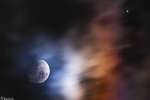
How many moons do you see? Many people would say one, referring to the Earth's Moon, prominent on the lower left. But take a closer look at the object on the upper right.
 APOD: 2025 January 12 Б Mimas: Small Moon with a Big Crater
12.01.2025
Whatever hit Mimas nearly destroyed it. What remains is one of the largest impact craters on one of Saturn's smallest round moons. Analysis indicates that a slightly larger impact would have destroyed Mimas entirely.
 Saturn, Titan, Rings, and Haze
29.07.2013
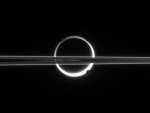
This is not a solar eclipse. Pictured above is a busy vista of moons and rings taken at Saturn. The large circular object in the center of the image is Titan, the largest moon of Saturn and one of the most intriguing objects in the entire Solar System.
 The Snows of Churyumov Gerasimenko
26.04.2018
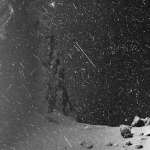
You couldn't really be caught in this blizzard while standing by a cliff on Churyumov-Gerasimenko, also known as comet 67P. Orbiting the comet in June of 2016 the Rosetta spacecraft's narrow angle...
 APOD: 2024 September 9 Б Mars: Moon, Craters, and Volcanos
9.09.2024
If you could fly over Mars, what might you see? The featured image shows exactly this in the form of a Mars Express vista captured over a particularly interesting region on Mars in July. The picture's most famous feature is Olympus Mons, the largest volcano in the Solar System, visible on the upper right.
|
January February March April May June July August September October |
|||||||||||||||||||||||||||||||||||||||||||||||||