
|
You entered: image
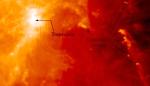 Cometary Globules In Orion
24.09.1999
Intense ultraviolet light from massive, hot stars in the Orion region has sculpted and compressed clouds of dust and gas in to distinctively shaped Cometary Globules. Seen in this IRAS infrared image recorded...
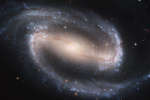 Barred Spiral Galaxy NGC 1300
22.06.2008
Big, beautiful, barred spiral galaxy NGC 1300 lies some 70 million light-years away on the banks of the constellation Eridanus. This Hubble Space Telescope composite view of the gorgeous island universe is one of the largest Hubble images ever made of a complete galaxy.
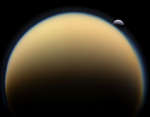 Tethys Behind Titan
26.01.2010
What's that behind Titan? It's another of Saturn's moons: Tethys. The robotic Cassini spacecraft orbiting Saturn captured the heavily cratered Tethys slipping behind Saturn's atmosphere-shrouded Titan late last year. The largest crater on Tethys, Odysseus, is easily visible on the distant moon.
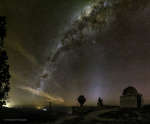 Milky Way over Bosque Alegre Station in Argentina
21.09.2015
What are those streaks of light in the sky? First and foremost, the arching structure is the central band of our Milky Way galaxy. Visible in this galactic band are millions of distant stars mixed with numerous lanes of dark dust.
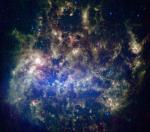 The Large Magellanic Cloud in Infrared
4.09.2006
Where does dust collect in galaxies? To help find out, a team of researchers took the most detailed image ever of gas clouds and dust in the neighboring Large Magellanic Cloud (LMC) galaxy.
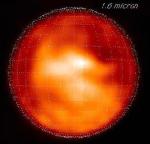 The Surface of Titan
20.08.2000
If sailing the hydrocarbon seas of Titan, beware of gasoline rain. Such might be a travel advisory issued one future day for adventurers visiting Titan, the largest moon of Saturn. New images of Titan's surface were released last week from the Canada-France Hawaii Telescope featuring the finest details yet resolved.
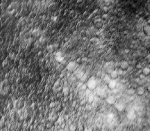 The Crater Chain
15.07.1995
NASA's robot spaceprobe Voyager 1, took this closeup image of the surface of Jupiter's crater scarred moon Callisto in 1979. A mysterious chain of craters is seen to extend diagonally across the image (upper left to lower right). What could cause the craters to line up in such a regular fashion?
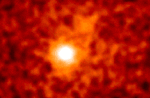 A Quasar in the Gamma Ray Sky
16.11.1996
The bright object in the center of the false color image above is quasar 3C279 viewed in gamma-rays, photons with more than 40 million times the energy of visible light. Like all quasars, 3C279 is a nondescript, faint, starlike object in the visible sky.
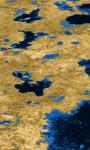 Liquid Lakes on Saturns Titan
6.02.2007
Why would some regions on Titan reflect very little radar? The leading explanation is that these regions are lakes, possibly composed of liquid methane. The above image is a false-color synthetic radar map of a northern region of Titan taken during a flyby of the cloudy moon by the robotic Cassini spacecraft last July.
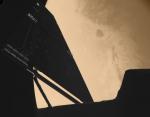 Rosetta Over Mars
28.02.2007
Panels on ESA's Rosetta spacecraft appear in the foreground of this intriguing image of Mars recorded on February 25 at a range of about 1,000 kilometers. Launched in March 2004, Rosetta...
|
January February March April May June July August September |
|||||||||||||||||||||||||||||||||||||||||||||||||