
|
You entered: Observatory
 Recycling Cassiopeia A
1.06.2023
Massive stars in our Milky Way Galaxy live spectacular lives. Collapsing from vast cosmic clouds, their nuclear furnaces ignite and create heavy elements in their cores. After a few million years, the enriched material is blasted back into interstellar space where star formation can begin anew.
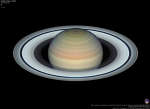 Saturn near Opposition
17.06.2017
Saturn reached its 2017 opposition on June 16. Of course, opposition means opposite the Sun in Earth's sky and near opposition Saturn is up all night, at its closest and brightest for the year.
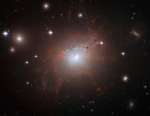 Active Galaxy NGC 1275
22.08.2008
Active galaxy NGC 1275 is the central, dominant member of the large and relatively nearby Perseus Cluster of Galaxies. A prodigious source of x-rays and radio emission, NGC 1275 accretes matter as entire galaxies fall into it, ultimately feeding a supermassive black hole at the galaxy's core.
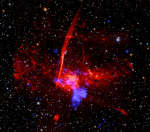 APOD: 2026 June 18 Б Possible Supernova Remnant in Galactic Center
18.06.2026
Do you see that blue blob to the lower right of the image center? Astronomers think that it shows where a massive star exploded as a supernova whose light reached Earth 1,700 years ago.
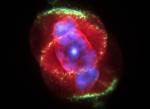 X-rays From The Cat's Eye
11.01.2001
Haunting patterns within planetary nebula NGC 6543 readily suggest its popular moniker -- the Cat's Eye nebula. In 1995, a stunning false-color optical image from the Hubble Space Telescope detailed the swirls of this glowing nebula, known to be the gaseous shroud expelled from a dying sun-like star about 3,000 light-years from Earth.
 Periodic Comet Swift-Tuttle
19.02.1996
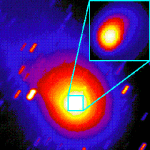
Comet Swift-Tuttle, shown above in false color, is the largest object known to make repeated passes near the Earth. It is also one of the oldest known periodic comets with sightings spanning two millennia.
 Black Holes Are Black
19.01.2001
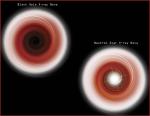
Q: Why are black holes black? A: Because they have an event horizon. The event horizon is that one-way boundary predicted by general relativity beyond which nothing, not even light, can return. X-ray astronomers...
 GLAST Gamma Ray Sky Simulation
22.07.2000
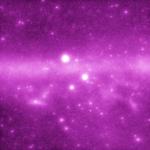
What shines in the gamma-ray sky? This simulated image models the intensities of gamma rays with over 40 million times the energy of visible light, and represents how the sky might appear to the Gamma-ray Large Area Space Telescope (GLAST) after its first year in orbit.
 Inside the Eagle Nebula
3.02.2012
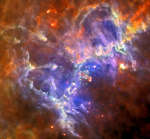
In 1995, a now famous picture from the Hubble Space Telescope featured Pillars of Creation, star forming columns of cold gas and dust light-years long inside M16, the Eagle Nebula. This remarkable false-color composite image revisits the nearby stellar nursery with image data from the orbiting Herschel Space Observatory and XMM-Newton telescopes.
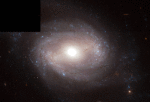 Hubble's Constant And The Expanding Universe (II)
14.05.1996
In this century, the discovery that the Universe is expanding has produced a revolution in human thought about the Cosmos. American astronomer Edwin Hubble played a major role in this profound discovery, coining the "Hubble constant".
|
January February March April May June July August September October |
|||||||||||||||||||||||||||||||||||||||||||||||||