
|
You entered: Observatory
 A Mystery in Gamma Rays
3.04.2004
Gamma rays are the most energetic form of light, packing a million or more times the energy of visible light photons. If you could see gamma rays, the familiar skyscape of steady stars would be replaced by some of the most bizarre objects known to modern astrophysics -- and some which are unknown.
 Fermi's First Light
28.08.2008
Launched on June 11 to explore the universe at extreme energies, the Gamma-ray Large Area Space Telescope has been officially renamed the Fermi Gamma-ray Space Telescope, in honor of Nobel Laureate Enrico Fermi (1901-1954), pioneer in high-energy physics.
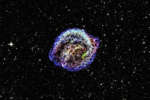 Kepler's Supernova Remnant in X Rays
15.05.2013
What caused this mess? Some type of star exploded to create the unusually shaped nebula known as Kepler's supernova remnant, but which type? Light from the stellar explosion that created this energized cosmic cloud was first seen on planet Earth in October 1604, a mere four hundred years ago.
 Unexpected X Rays from Perseus Galaxy Cluster
1.01.2018
Why does the Perseus galaxy cluster shine so strangely in one specific color of X-rays? No one is sure, but a much-debated hypothesis holds that these X-rays are a clue to the long-sought identity of dark matter.
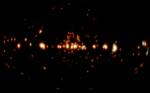 A Mystery in Gamma Rays
23.03.2000
Gamma rays are the most energetic form of light, packing a million or more times the energy of visible light photons. What if you could see gamma rays? If you could, the familiar skyscape...
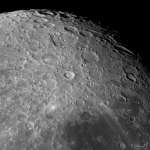 Tycho and Clavius
4.08.2021
South is up in this detailed telescopic view across the Moon's rugged southern highlands. Captured on July 20, the lunar landscape features the Moon's young and old, the large craters Tycho and Clavius.
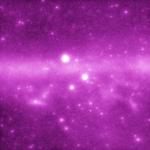 GLAST Gamma Ray Sky Simulation
11.11.1998
This simulated image models the intensities of gamma rays with over 40 million times the energy of visible light, and represents how the sky might appear to the proposed Gamma-ray Large Area Space Telescope (GLAST) after its first year in orbit.
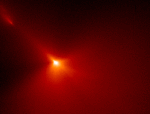 Near the Nucleus of Hyakutake
27.03.1996
NASA's Hubble Space Telescope captured this image of the near-nuclear region of Comet Hyakutake on March 25 as the comet approached within 9.3 million miles of the Earth. It covers a relatively "small" 2,000 mile wide area with the sunward direction toward the lower right (tailward is upper left).
 The GRB 110328A Symphony
19.04.2011
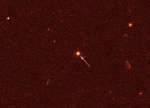
A symphony of planet-wide observations began abruptly on March 28 when the Earth-orbiting Swift satellite detected a burst of high-frequency gamma-rays from GRB 110328A. When the same source flared again after a 45 minute pause it was clear this event was not a typical gamma-ray burst.
 Worlds of a Distant Sun: 47 Ursae Majoris b
1.07.1996
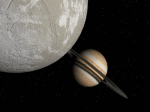
Within the last few years, observational astronomy has given humanity evidence of the existence of worlds beyond the solar system. Indeed, solar-type stars are now inferred to harbor planets of approximately Jupiter mass - some residing in temperature zones which could conceivably support liquid water and therefore life!
|
January February March April May June July August September October |
|||||||||||||||||||||||||||||||||||||||||||||||||