
|
You entered: Earth
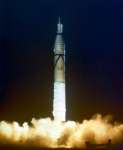 The First Explorer
1.02.2008
Fifty years ago (on January 31, 1958) the First Explorer, was launched into Earth orbit by the Army Ballistic Missile Agency. Inaugurating the era of space exploration for the United States, Explorer I was a thirty pound satellite that carried instruments to measure temperatures, and micrometeorite impacts, along with an experiment designed by James A.
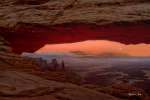 Otherworldly Planet Rise
11.04.2011
What would a sunrise look like on another world? So far, humanity has only recorded sunrises on Mars and Earth, but it is fun to wonder what they would look like on planets known and yet unknown.
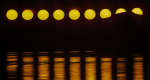 Venus Transits the Midnight Sun
20.06.2012
Today's solstice, the astronomical beginning of summer in the north, is at 23:09 UT when the Sun reaches the northernmost declination in its yearly trek through planet Earth's sky. While most...
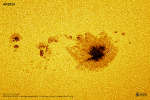 AR2835: Islands in the Photosphere
2.07.2021
Awash in a sea of incandescent plasma and anchored in strong magnetic fields, sunspots are planet-sized dark islands in the solar photosphere, the bright surface of the Sun. Found in solar active regions, sunspots...
 Saturn: 1993 2022
19.08.2022
Saturn is the most distant planet of the Solar System easily visible to the unaided eye. With this extraordinary, long-term astro-imaging project begun in 1993, you can follow the ringed gas giant for one Saturn year as it wanders once around the ecliptic plane, finishing a single orbit around the Sun by 2022.
 Julius Caesar and Leap Days
29.02.2000
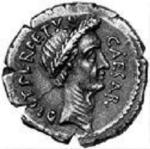
Even as leap days go, today is a remarkable one. In 46 BC, Julius Caesar, pictured above in a self-decreed minted coin, created a calendar system that added one leap day every four years.
 The Averted Side Of The Moon
21.10.2000
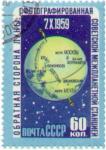
This vintage 60-kopek stamp celebrates a dramatic achievement. On the 7th of October, 1959 (7/X/1959), the Soviet interplanetary station which has come to be called "Luna 3" successfully photographed the far side of the moon giving denizens of planet Earth their first ever view of this hidden hemisphere.
 Apogee Moon, Perigee Moon
21.10.2004
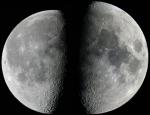
Why don't these pieces fit? This third quarter Moon (left) and first quarter Moon were both photographed during the last lunar cycle or lunation with the same telescope and camera. But, simply combining the pictures into one sharp, full surface view would clearly be a problem.
 Sun Block
18.08.1999
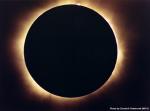
During a total solar eclipse, Earth's moon blocks the sun - almost exactly. While the sun is about 400 times wider than the moon, it is also about 400 times farther away and each appears to be half a degree or so in diameter.
 Moonrise Through Mauna Keas Shadow
5.12.2010
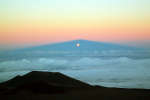
How can the Moon rise through a mountain? It cannot -- what was photographed here is a moonrise through the shadow of a large volcano. The volcano is Mauna Kea, Hawai'i, USA, a frequent spot for spectacular photographs since it is arguably the premier observing location on planet Earth.
|
January February March April May June July August September October |
|||||||||||||||||||||||||||||||||||||||||||||||||