
|
You entered: Earth
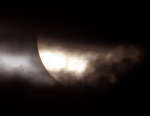 Mercurys Transit: An Unusual Spot on the Sun
24.08.2014
What's that dot on the Sun? If you look closely, it is almost perfectly round. The dot is the result of an unusual type of solar eclipse that occurred in 2006. Usually it is the Earth's Moon that eclipses the Sun. This time, the planet Mercury took a turn.
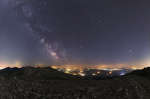 Summer Planets and Milky Way
22.07.2016
Lights sprawl toward the horizon in this night skyscape from Uludag National Park, Bursa Province, Turkey, planet Earth. The stars and nebulae of the Milky Way are still visible though, stretching above the lights on the northern summer night while three other planets shine brightly.
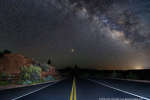 Road to Mars
8.07.2018
What's that light at the end of the road? Mars. This is a good month to point out Mars to your friends and family because our neighboring planet will not only be its brightest in 15 years, it will be visible for much of night.
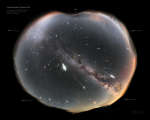 Perseids from Perseus
9.08.2020
Where are all these meteors coming from? In terms of direction on the sky, the pointed answer is the constellation of Perseus. That is why the meteor shower that peaks tomorrow night is known as the Perseids -- the meteors all appear to came from a radiant toward Perseus.
 APOD: 2023 December 17 Б Geminids over Chinas Nianhu Lake
16.12.2023
Where are all of these meteors coming from? In terms of direction on the sky, the pointed answer is the constellation of Gemini. That is why the major meteor shower in December is known as the Geminids -- because shower meteors all appear to come from a radiant toward Gemini.
 Phobos: Moon over Mars
21.03.2024
A tiny moon with a scary name, Phobos emerges from behind the Red Planet in this timelapse sequence from the Earth-orbiting Hubble Space Telescope. Over 22 minutes the 13 separate exposures were captured near the 2016 closest approach of Mars to planet Earth. Martians have to look to the west to watch Phobos rise, though.
 APOD: 2026 February 1 Б Galle: Happy Face Crater on Mars
31.01.2026
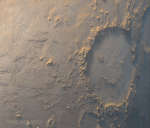
Mars has put on a happy face. The Martian crater Galle is famous because it has internal markings that make it look like a face that is both smiling and winking. These markings were originally discovered in the 1970s in pictures taken by the Viking Orbiter.
 Hale-Bopp on Schedule
25.07.1996
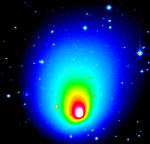
Late March and early April of 1996 marked a banner season for viewing the spectacular naked-eye comet Hyakutake. The spring of 1997 could well offer a similar cometary wonder, Comet Hale-Bopp. Discovered last year while approaching the inner solar sytem Hale-Bopp has been eagerly watched for signs that it will indeed brighten spectacularly.
 A Total Lunar Eclipse Over Tajikistan
6.11.2022
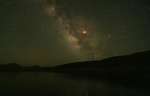
If the full Moon suddenly faded, what would you see? The answer was recorded in a dramatic time lapse video taken during the total lunar eclipse in 2011 from Tajikistan. During a total lunar eclipse, the Earth moves between the Moon and the Sun, causing the moon to fade dramatically.
 Martian Dust Storm
27.07.2001
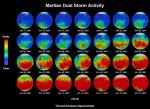
If you've been unhappy with the weather on Earth, check out Mars, now in the grip of a planet-wide dust storm. Above, observations from the orbiting Mars Global Surveyor (MGS) spacecraft illustrate the storm's progress through July 21.
|
January February March April May June July August September October |
|||||||||||||||||||||||||||||||||||||||||||||||||