
|
You entered: Earth
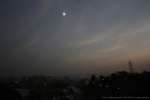 Eclipse over Chongqing, China
24.07.2009
The daytime sky grew dark, the temperature dropped, and lights came on as Chongqing, China, was plunged into the Moon's shadow during the July 22nd total solar eclipse. This serene, wide-angle view of the event looks to the east over the large, populous city from a newly constructed park.
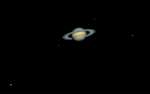 Six Moons of Saturn
14.04.2012
How many moons does Saturn have? So far 62 have been discovered, the smallest only a fraction of a kilometer across. Six of its largest satellites can be seen here, though, in a sharp Saturnian family portrait taken on March 9.
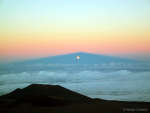 Moonrise Through Mauna Keas Shadow
3.05.2015
How can the Moon rise through a mountain? It cannot -- what was photographed here is a moonrise through the shadow of a large volcano. The volcano is Mauna Kea, Hawai'i, USA, a frequent spot for spectacular photographs since it is arguably the premier observing location on planet Earth.
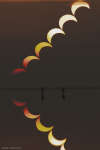 A Partial Solar Eclipse Sequence Reflected
27.12.2019
What's happened to the Sun? Yesterday, if you were in the right place at the right time, you could see the Sun rise partially eclipsed by the Moon. The unusual sight was captured...
 Tempel Tuttle: The Leonid Comet
16.11.2002
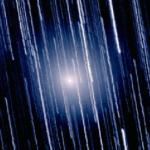
Star trails streak this composite time exposure of comet Tempel-Tuttle recorded by Tim Puckett on January 26, 1998. Then passing through the inner solar system on its 33 year orbit around the Sun, Tempel-Tuttle brightened unexpectedly, but binoculars or small telescopes were still required to visually observe it.
 Mars, Ceres, Vesta
10.04.2014
That bright, ruddy star you've recently noticed rising just after sunset isn't a star at all. That's Mars, the Red Planet. Mars is now near its 2014 opposition (April 8) and closest approach (April 14), looping through the constellation Virgo opposite the Sun in planet Earth's sky.
 Spot The Planet
10.12.1999
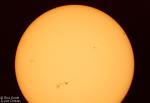
OK, it's a picture of the Sun (duh!), but can you spot the planet? Of course, most of the spots you've spotted are sunspots, as large or larger than planet Earth itself.
 Swift RocketCam
24.12.2004
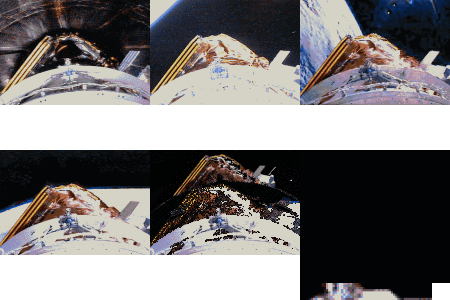
A forward-facing RocketCam (TM) mounted inside the payload fairing of a Delta II rocket captured these dramatic video frames on November 20th -- as the Swift satellite observatory journeyed to an orbit 600 kilometers above planet Earth. Some frames were interpolated to correct for transmission problems.
 ISS and the Summer Milky Way
24.01.2013
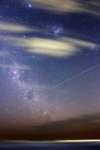
Clouds on a summer night frame this sea and skyscape, recorded earlier this month near Buenos Aires, Argentina. But planet Earth's clouds are not the only clouds on the scene. Starry clouds...
 Milky Way Over Quiver Tree Forest
15.05.2016
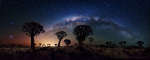
In front of a famous background of stars and galaxies lies some of Earth's more unusual trees. Known as quiver trees, they are actually succulent aloe plants that can grow to tree-like proportions. The quiver tree name is derived from the historical usefulness of their hollowed branches as dart holders.
|
January February March April May June July August September October |
|||||||||||||||||||||||||||||||||||||||||||||||||