
|
You entered: Earth
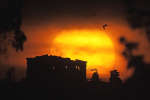 Sunrise over the Parthenon
21.06.2009
Today, the sun will stay in the sky longer than any other day of the year, as seen from the northern hemisphere of Earth. Named the Summer Solstice, today's maximum daylight is indicative of the high amount of sunlight this time of year that is primarily responsible for the heat of the summer season.
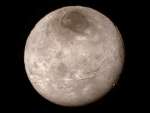 Charon
17.07.2015
Icy world Charon is 1,200 kilometers across. That makes Pluto's largest moon only about 1/10th the size of planet Earth but a whopping 1/2 the diameter of Pluto itself. Charon is seen in unprecedented detail in this image from New Horizons.
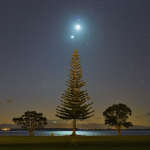 Comet PanSTARRS, Moon, and Venus
23.07.2015
It is the object to the left of the big tree that's generating much recent excitement. If you look closely, there you can see Comet PanSTARRS, complete with two tails. During July, this comet has increased markedly in brightness and has just passed its closest approach to Earth.
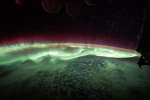 Aurora Slathers up the Sky
29.07.2017
Like salsa verde on your favorite burrito, a green aurora slathers up the sky in this June 25 snapshot from the International Space Station. About 400 kilometers (250 miles) above Earth, the orbiting station is itself within the upper realm of the auroral displays.
 The First Explorer
31.01.2018
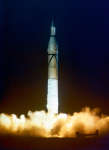
Sixty years ago, on January 31, 1958, the First Explorer was successfully launched by the Army Ballistic Missile Agency on a Jupiter-C rocket. Inaugurating the era of space exploration for the United States, Explorer...
 Planetary Alignment over Italy
19.12.2021
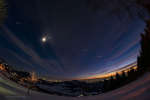
It is not a coincidence that planets line up. That's because all of the planets orbit the Sun in (nearly) a single sheet called the plane of the ecliptic. When viewed from inside that plane -- as Earth dwellers are likely to do -- the planets all appear confined to a single band.
 Gliese 876 System Includes Large Terrestrial Planet
14.06.2005
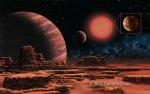
Is our Earth unique? In continuing efforts to answer this question, astronomers have now discovered an Earth-like planet orbiting a distant normal star. Previously over 150 gas-giant planets like Jupiter had been so discovered.
 An Anomalous SETI Signal
7.03.2004
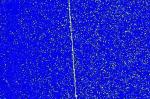
No one knows for sure what caused this signal. There is a slight possibility that it just might originate from an extraterrestrial intelligence. The bright colors on the blue background indicate that an anomalous signal was received here on Earth by a radio telescope involved in a Search for Extraterrestrial Intelligence (SETI).
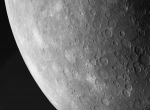 Southwest Mercury
13.02.2000
The planet Mercury resembles a moon. Mercury's old surface is heavily cratered like many moons. Mercury is larger than most moons but smaller than Jupiter's moon Ganymede and Saturn's moon Titan. Mercury is much denser and more massive than any moon, though, because it is made mostly of iron.
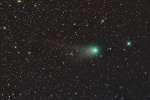 Tails of Comet Garradd
20.10.2011
A good target for binoculars and small telescopes, Comet Garradd (C/2009 P1) now shines in planet Earth's evening skies, a steady performer but just below naked-eye visibility. Telescopic images like this composite from...
|
January February March April May June July August September October |
|||||||||||||||||||||||||||||||||||||||||||||||||