
|
You entered: clouds
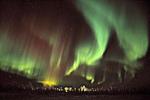 Aurora Over Circle, Alaska
1.01.1997
Aurora can make spectacular sights. This particular aurora was photographed hovering over the town of Circle, Alaska. Although Aurora might first appear to be moonlit clouds, they only add light to the sky, and hence can not block background stars from view.
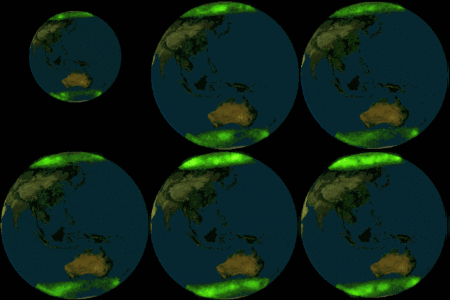 Auroras Over Both Earth Poles
14.11.2001
Auroras in the north and south can be nearly mirror images of each other. Such mirroring had been suspected for centuries but dramatically confirmed only last month by detailed images from NASA's orbiting Polar spacecraft.
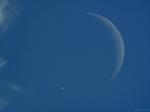 A Daylight Eclipse of Venus
20.06.2007
Something was about to happen. Just two days ago, two of the three celestial objects easily visible during the day appeared to collide. But actually, Earth's Moon passed well in front of the distant planet Venus. The occultation was caught from Switzerland in the hours before sunset.
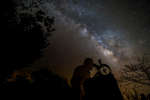 Along the Milky Way
3.07.2021
You can't walk along the Milky Way. Still, under a dark sky you can explore it. To the eye the pale luminous trail of light arcing through the sky on a dark, moonless night does appear to be a path through the heavens.
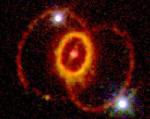 The Mysterious Rings of Supernova 1987A
31.03.2002
What's causing those odd rings in supernova 1987A? In 1987, the brightestsupernova in recent history occurred in the Large Magellanic Clouds. At the center of the picture is an object central to the remains of the violent stellar explosion.
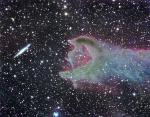 CG4: A Ruptured Cometary Globule
13.10.2002
The odd looking "creature" to the right of center in the above photo is a gas cloud known as a cometary globule. This globule, however, has ruptured. Cometary globules are typically characterized by dusty heads and elongated tails.
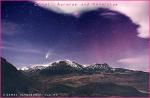 Big Sky Comet
21.04.1997
On April 17th, "Big Sky" country sure lived up to its name. The dark skies over the US states of Wyoming, Montana and the Dakotas were quite busy, as shown by this photograph featuring Comet Hale-Bopp. In the foreground is the Absaroka Mountain Range in Wyoming, lit by reflected moonlight.
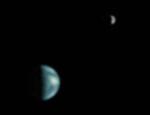 The Earth and Moon from Mars
26.05.2003
What does Earth look like from Mars? The first image of Earth from the red planet was captured earlier this month by the camera onboard the Mars Global Surveyor spacecraft currently orbiting Mars. Features visible on Earth include the Pacific Ocean, clouds, much of South America, and part of North America.
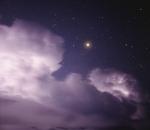 A Dark and Stormy Night
31.10.2003
It was a dark and stormy night. But on August 29th the red planet Mars, near it's closest approach to Earth in almost 60,000 years, shone brightly in the sky against a background of stars in the constellation Aquarius.
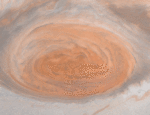 Galileo Zooms in on Jupiter's Red Spot
27.08.1996
What does the largest storm system ever recorded look like close-up? This storm system is Jupiter's Great Red Spot and it was captured recently in detail by the robot spacecraft Galileo now in orbit around Jupiter.
|
January February March April May June July August September October |
|||||||||||||||||||||||||||||||||||||||||||||||||