
|
You entered: clouds
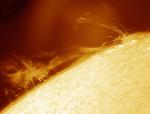 At the Edge of the Sun
7.07.2003
Dramatic prominences can sometimes be seen looming just beyond the edge of the sun. A solar prominence is a cloud of solar gas held just above the surface by the Sun's magnetic field. The Earth would easily fit below the prominence on the left.
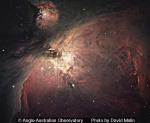 Water From Orion
21.04.1998
Is Orion all wet? Recent observations have confirmed that water molecules now exist in the famous Orion Nebula, and are still forming. The Orion Nebula (M42, shown above) is known to be composed mostly of hydrogen gas, with all other atoms and molecules being comparatively rare.
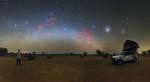 A Kalahari Sky
30.05.2017
You wake up in the Kalahari Desert in Botswana, Africa. You go outside your tent, set up your camera, and take long exposures of the land and sky. What might you see? Besides a lot of blowing dust and the occasional acacia tree, you might catch many sky wonders.
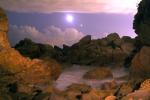 Moon and Venus over Corona Del Mar Beach
8.03.2004
The crescent Moon passed nearly in front of Venus last week. The close conjunction of the night sky's two brightest objects created a striking pose for many viewing the evening sky just after sunset. Such a pose, shown above, was captured between clouds over Corona Del Mar Beach in California, USA.
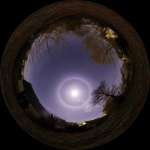 Circle Around the Moon
13.02.2009
If your sister-in-law phoned you at 1am to tell you there was a circle around the Moon, how would you react? When it happened to him early last Sunday morning, photographer Laurent Laveder, grabbed his equipment and ran outside!
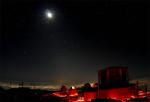 Moon Over Haleakala
10.06.2006
A waxing crescent Moon shines over the caldera of dormant volcano Haleakala and observatory domes in this dramatic view from above the clouds. Looking west from Maui, Hawaii on May 31st, the scene also records the lights of Honolulu on the horizon.
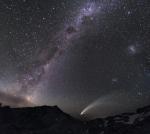 Three Galaxies and a Comet
30.03.2007
Diffuse starlight and dark nebulae along the southern Milky Way arc over the horizon and sprawl diagonally through this gorgeous nightscape. The breath-taking mosaic spans a wide 100 degrees, with the rugged terrain of the Patagonia, Argentina region in the foreground.
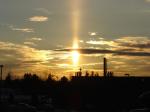 A Sun Pillar Over Maine
2.01.2006
Have you ever seen a sun pillar? When the air is cold and the Sun is rising or setting, falling ice crystals can reflect sunlight and create an unusual column of light. Ice sometimes forms flat, stop-sign shaped crystals as it falls from high-level clouds.
 Mauna Kea Shadow Play
1.03.2008
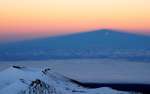
Just opposite the setting Sun, the already-eclipsed Moon rose over the Hawaiian Islands on February 20. A view near the 14,000 foot peak of volcanic Mauna Kea on the Big Island, a popular spot for astronomers, offered this remarkable play of shadows and sunlight.
 Night Hides the World
7.02.2014
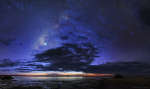
Stars come out as evening twilight fades in this serene skyscape following the Persian proverb "Night hides the world, but reveals a universe." In the scene from last November, the Sun is setting over northern Kenya and the night will soon hide the shores of Lake Turkana, home to many Nile crocodiles.
|
January February March April May June July August September October |
|||||||||||||||||||||||||||||||||||||||||||||||||