
|
You entered: Earth orbit
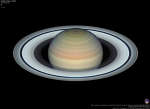 Saturn near Opposition
16.06.2017
Saturn reached its 2017 opposition on June 16. Of course, opposition means opposite the Sun in Earth's sky and near opposition Saturn is up all night, at its closest and brightest for the year.
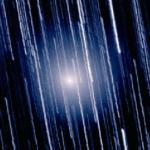 Tempel Tuttle: The Leonid Comet
12.11.1999
Star trails streak this composite time exposure of Comet Tempel-Tuttle recorded by T. Puckett on January 26, 1998. Then passing through the inner solar system on its 33 year orbit around the Sun, Tempel-Tuttle brightened unexpectedly, but binoculars or small telescopes were still required to visually observe it.
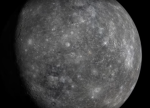 Mercury Visualized from MESSENGER
10.12.2017
What would it be like to fly over the planet Mercury? Images and data taken from NASA's robotic MESSENGER spacecraft that orbited Mercury from 2011 to 2015 have been digitally combined to envision a virtual flight that highlights much of the hot planet's surface.
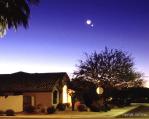 Venus, Moon, and Neighbors
6.04.2000
Rising before the Sun on February 2nd, astrophotographer Joe Orman anticipated this apparition of the bright morning star Venus near a lovely crescent Moon above a neighbor's house in suburban Phoenix, Arizona, USA.
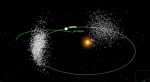 The Case of the Backwards Orbiting Asteroid
29.05.2018
Why does asteroid 2015 BZ509 orbit the Sun the backwards? As shown in the featured animation, Jupiter's trojan asteroids orbit the Sun in two major groups -- one just ahead of Jupiter, and one just behind -- but all orbit the Sun in the same direction as Jupiter.
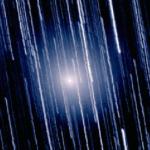 Tempel-Tuttle: The Leonid Comet
29.01.1998
Star trails streak this composite time exposure of Comet Tempel-Tuttle recorded by T. Puckett on January 26. Presently passing through the inner solar system on its 33 year orbit around the Sun, Tempel-Tuttle has brightened unexpectedly, but binoculars or small telescopes are still required to visually observe it.
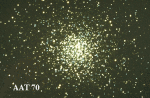 Globular Cluster M5
18.10.1995
The globular cluster M5, pictured above, contains roughly 100,000 stars. These stars formed together and are gravitationally bound. Stars orbit the center of the cluster, and the cluster orbits the center of our Galaxy. So far, about 160 globular clusters are known to exist in a roughly spherical halo around the Galactic center.
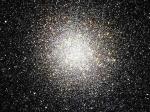 Globular Cluster M22 from CFHT
27.06.2005
The globular cluster M22, pictured above, contains over 100,000 stars. These stars formed together and are gravitationally bound. Stars orbit the center of the cluster, and the cluster orbits the center of our Galaxy. So far, about 140 globular clusters are known to exist in a roughly spherical halo around the Galactic center.
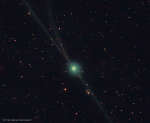 Almost Three Tails for Comet Encke
19.02.2017
How can a comet have three tails? Normally, a comet has two tails: an ion tail of charged particles emitted by the comet and pushed out by the wind from...
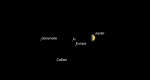 Juno Approaching Jupiter
30.06.2016
Approaching over the north pole after nearly a five-year journey, Juno enjoys a perspective on Jupiter not often seen, even by spacecraft from Earth that usually swing by closer to Jupiter's equator. Looking...
|
January February March April May June July August September October |
|||||||||||||||||||||||||||||||||||||||||||||||||