
|
You entered: dark
 Io: The Fissure King?
29.11.1996
Is Io the solar system's Fissure King? Well, probably not ... but it is the most active volcanic moon. Active volcanoes on Jupiter's moon Io were a surprise discovery of the Voyager missions of the late 1970s.
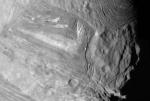 Miranda
19.02.1998
Miranda is a bizarre world which surely had a tempestuous past. The innermost of the larger Uranian moons, Miranda is almost 300 miles in diameter and was discovered only 50 years ago (February 16, 1948) by the renown American planetary astronomer Gerard Kuiper.
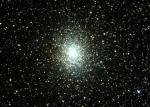 Globular Cluster M19
19.07.2000
M19 appears to be a typical globular cluster of stars - except for its shape. If one looks closely at the cluster, pictured above, it appears to be longer (top to bottom) than it is wide.
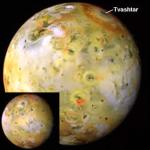 A Newly Active Volcano On Jupiters Io
16.10.2001
Would a volcano plume discovered in January above Jupiter's Moon Io still be active months later? To answer this question, the robot spacecraft Galileo currently in orbit around Jupiter was maneuvered to image the plume site during its recent flyby of Io in August.
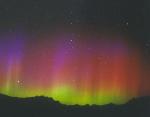 Meteors and Northern Lights
15.08.2002
Skygazers report that the annual Perseid meteor shower went pretty much as predicted, producing a meteor every few minutes during the dark early morning hours of August 12 and 13. And as the constellation...
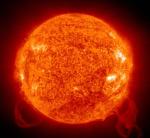 Double Eruptive Prominences
18.04.2003
Lofted over the Sun on looping magnetic fields, large solar prominences are composed of relatively cool, dense plasma. When seen against the brilliant solar disk they appear as dark filaments, but these enormous magnetic...
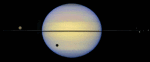 Saturn's Rings Seen Sideways
24.05.1997
Saturn's rings are actually very thin. This picture from the Hubble Space Telescope was taken on August 6, 1995 when the rings lined up sideways as seen from Earth. Saturn's largest moon Titan is seen on the left, and Titan's shadow can be seen on Saturn's cloud tops!
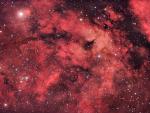 A Cygnus Star Field
28.07.2004
In the constellation of the swan near the nebula of the pelican lies the gas cloud of the butterfly surrounding a star known as the hen. That star, given the proper name Sadr, is visible to the unaided eye but found here as the brightest object on the upper left.
 A Time Lapse Lunar Eclipse
3.11.2004
During last week's lunar eclipse, our Moon appeared to disappear. As the Earth moved between the Moon and the Sun, the Earth's shadow fell on the moon, making it quite dark.
 Four Faces of Mars
5.07.1999
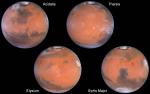
As Mars rotates, most of its surface becomes visible. During Earth's recent pass between Mars and the Sun, the Hubble Space Telescope was able to capture the most detailed time-lapse pictures ever from the Earth. Dark and light sand and gravel create an unusual blotted appearance for the red planet.
|
January February March April May June July August September |
|||||||||||||||||||||||||||||||||||||||||||||||||