
|
You entered: dark
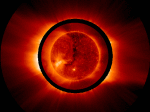 A Wind From The Sun
18.03.2000
A wind from the Sun blows through our Solar System. The behaviour of comet tails as they flapped and waved in this interplanetary breeze gave astronomers the first hint of its existence. Streaming outward at 250-400 miles/second, electrons and ions boiling off the Sun's incredibly hot
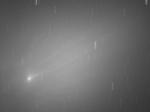 The Inner Coma of Comet Holmes
13.11.2007
What's happening to Comet Holmes? The rare comet remains visible to the unaided eyes of northern observers as an unusual small puff ball in the constellation of Perseus. A high resolution set of images of the comet's inner coma, taken last week and shown above, reveals significant detail.
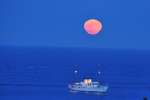 Seaside Moon Mirage
20.06.2009
This surprising view of the Full Moon rising on June 7 was captured with a telephoto lens from a seaside balcony near Nice, France. The orange Moon's dark markings and odd shape put the photographer in mind of an alien creature's face staring down at the passing ship.
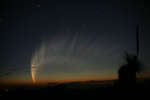 The Magnificent Tail of Comet McNaught
6.12.2009
Comet McNaught, the Great Comet of 2007, was the brightest comet of the last 40 years. Its spectacular tail spread across the sky and was breathtaking to behold from dark locations for many Southern Hemisphere observers.
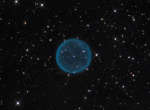 Spherical Planetary Nebula Abell 39
8.10.2012
Ghostly in appearance, Abell 39 is a remarkably simple, spherical nebula about five light-years across. Well within our own Milky Way galaxy, the cosmic sphere is roughly 7,000 light-years distant toward the constellation Hercules.
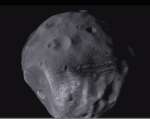 Phobos 360
25.12.2013
What does the Martian moon Phobos look like? To better visualize this unusual object, images from ESA's Mars Express orbiter have been combined into a virtual rotation movie. The rotation is actually a digital illusion -- tidally-locked Phobos always keeps the same face toward its home planet, as does Earth's moon.
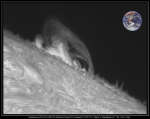 Sun and Prominence
4.03.2014
Dramatic prominences can sometimes be seen looming just beyond the edge of the sun. Such was the case last week as a large prominence, visible above, highlighted a highly active recent Sun. A waving...
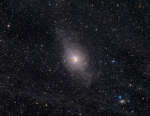 Centaurus A
9.03.2017
Only 11 million light-years away, Centaurus A is the closest active galaxy to planet Earth. Spanning over 60,000 light-years, the peculiar elliptical galaxy also known as NGC 5128, is featured in this sharp telescopic view.
 Space Station Silhouette on the Moon
2.04.2019
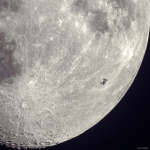
What's that unusual spot on the Moon? It's the International Space Station. Using precise timing, the Earth-orbiting space platform was photographed in front of a partially lit gibbous Moon last month. The featured image was taken from Palo Alto, California, USA with an exposure time of only 1/667 of a second.
 Chamaeleon I Molecular Cloud
17.02.2022
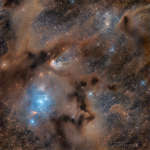
Dark markings and bright nebulae in this telescopic southern sky view are telltale signs of young stars and active star formation. They lie a mere 650 light-years away, at the boundary of the local bubble and the Chamaeleon molecular cloud complex.
|
January February March April May June July August September |
|||||||||||||||||||||||||||||||||||||||||||||||||