
|
You entered: dark
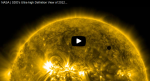 A Venus Transit Music Video from SDO
11.06.2012
What's that black dot moving across the Sun? Venus. Possibly the clearest view of Venus crossing in front of the Sun last week was from Earth orbit. The Solar Dynamics Observatory obtained an uninterrupted vista recording it not only in optical light but also in bands of ultraviolet light.
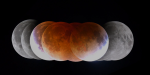 Time Lapse of a Total Lunar Eclipse
28.04.2014
Why would a bright full Moon suddenly become dark? Because it entered the shadow of the Earth. Almost two weeks ago this exact event happened as the Moon underwent a total lunar eclipse. That...
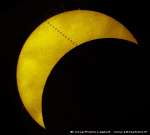 A Double Eclipse of the Sun
21.03.2015
Can the Sun be eclipsed twice at the same time? Last Friday was noteworthy because part of the Earth was treated to a rare total eclipse of the Sun. But also on Friday, from...
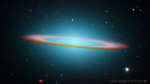 The Sombrero Galaxy in Infrared
4.10.2015
This floating ring is the size of a galaxy. In fact, it is a galaxy -- or at least part of one: the photogenic Sombrero Galaxy, one of the largest galaxies in the nearby Virgo Cluster of Galaxies.
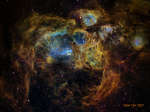 NGC 6357: The Lobster Nebula
26.12.2018
Why is the Lobster Nebula forming some of the most massive stars known? No one is yet sure. Cataloged as NGC 6357, the Lobster Nebula houses the open star cluster Pismis 24 near its center -- a home to unusually bright and massive stars.
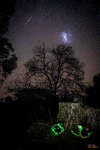 Ghost Fungus to Magellanic Cloud
23.05.2020
Stars shine and satellites glint in this clear, dark, night sky over Wannon Falls Reserve, South West Victoria, Australia. In fact the fuzzy, faint apparition above the tree tops is the only cloud visible, also known as the Large Magellanic Cloud, satellite galaxy of our own Milky Way.
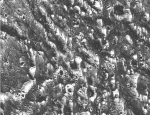 Ancient Cratered Plains on Ganymede
12.07.1996
The largest moon in the Solar System shows regions that are ancient and battered. The high density of craters demonstrate that patches of Ganymede are indeed billions of years old. This photo is one of a series released by NASA two days ago from the Galileo spacecraft orbiting Jupiter.
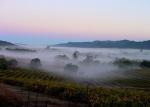 The Belt of Venus over the Valley of the Moon
21.10.2003
Although you've surely seen it, you might not have noticed it. During a cloudless twilight, just before sunrise or after sunset, part of the atmosphere above the horizon appears slightly off-color, slightly pink.
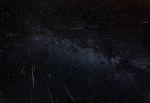 Raining Perseids
20.08.2004
Comet dust rained down on planet Earth last week, streaking through dark skies in the annual Perseid meteor shower. So, while enjoying the anticipated space weather, astronomer Fred Bruenjes recorded a series of many 30 second long exposures spanning about six hours on the night of August 11/12 using a wide angle lens.
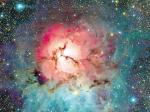 The Trifid Nebula from CFHT
31.05.2005
Unspeakable beauty and unimaginable bedlam can be found together in the Trifid Nebula. Also known as M20, this photogenic nebula is visible with good binoculars towards the constellation of Sagittarius. The energetic processes of star formation create not only the colors but the chaos. The red-glowing gas results from high-energy starlight striking interstellar hydrogen gas.
|
January February March April May June July August September |
|||||||||||||||||||||||||||||||||||||||||||||||||