
|
You entered: ring
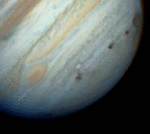 Comet Impacts on Jupiter
14.07.1995
In July of 1994, pieces of Comet Shoemaker-Levy 9, also known as the "string of pearls" comet, collided with the planet Jupiter. As the comet fragments smashed in to Jupiter, the resulting explosions scattered large quantities of dusty cometary debris into the Jovian atmosphere.
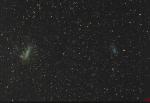 A Magellanic Mural
3.02.1998
Two galaxies stand out to casual observers in Earth's Southern Hemisphere: the Large Magellanic Cloud (LMC) and the Small Magellanic Cloud (SMC). These irregular galaxies are two of the closest galaxies to our Milky Way Galaxy.
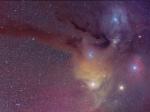 The Dark River to Antares
9.08.2004
Connecting the Pipe Nebula to the bright star Antares is a flowing dark cloud nicknamed the Dark River. The murkiness of the Dark River is caused by absorption of background starlight by dust, although the nebula contains mostly hydrogen and molecular gas.
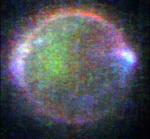 Io Aurora
16.10.1998
Alluring aurora surrounding Io (eye-oh) appear as a ghostly glow while the volcanic moon orbits within Jupiter's dark shadow. Gas giant Jupiter is off to the right of this image, recorded in May by the robot Galileo spacecraft's solid state imaging camera from a distance of about 1.3 million kilometers.
 A Slice Through an Artificial Universe
23.06.1998
We live in the era of humanity when most of our Universe is being mapped. To help understand these maps, astronomers computationally estimate the appearance of several possible candidate universes, to which maps of the real Universe can be compared.
 In Green Company: Aurora over Norway
2.11.2014
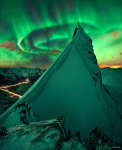
Raise your arms if you see an aurora. With those instructions, two nights went by with, well, clouds -- mostly. On the third night of returning to same peaks, though, the sky not only cleared up but lit up with a spectacular auroral display.
 The Cygnus Loop
8.08.1998
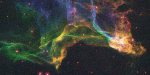
15,000 years ago a star in the constellation of Cygnus exploded -- the shockwave from this supernova explosion is still expanding into interstellar space! The collision of this fast moving wall of gas with...
 The Cygnus Loop
3.08.1997
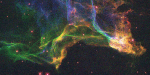
15,000 years ago a star in the constellation of Cygnus exploded -- the shockwave from this supernova explosion is still expanding into interstellar space! The collision of this fast moving wall of gas with...
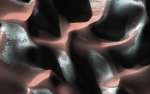 Martian Chiaroscuro
22.03.2014
Deep shadows create dramatic contrasts between light and dark in this high-resolution close-up of the martian surface. Recorded on January 24 by the HiRISE camera onboard the Mars Reconnaissance Orbiter, the scene spans about 1.5 kilometers across a sand dune field in a southern highlands crater.
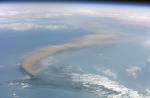 Mt Etna Eruption Plume
2.01.2003
Mt. Etna has been erupting for hundreds of thousands of years. In late October of last year, however, earthquakes triggered a particularly vigorous outburst from this well known volcano on the Italian island of Sicily.
|
January February March April May June July August September October |
|||||||||||||||||||||||||||||||||||||||||||||||||