
|
You entered: planet
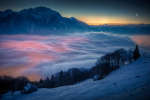 Moon and Venus over Switzerland
2.02.2011
Sometimes a morning sky can be a combination of serene and surreal. Such a sky perhaps existed before sunrise this past Sunday as viewed from a snowy slope in eastern Switzerland. Quiet clouds blanket the above scene, lit from beneath by lights from the village of TrЭbbach.
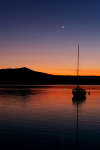 Conjunction at Sunset
29.12.2011
While Comet Lovejoy entertained early morning risers in in the southern hemisphere, a lovely conjunction of a young crescent Moon and Venus graced western skies at sunset. Captured on December 26th the conjunction, with beautiful sunset colors above and below, is seen here over Viverone Lake near Turin, Italy.
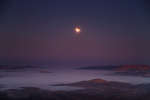 Eclipse at Moonset
9.10.2014
The Pacific Ocean and Chilean coast lie below this sea of clouds. Seen through the subtle colors of the predawn sky a lunar eclipse is in progress above, the partially eclipsed Moon growing dark.
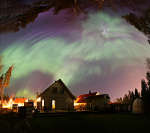 Aurora in the Backyard
18.03.2015
On the night of March 17/18 this umbrella of northern lights unfolded over backyards in Vallentuna, Sweden about 30 kilometers north of Stockholm. A result of the strongest geomagnetic storm of this solar cycle...
 A Rorschach Aurora
30.10.2021
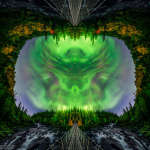
If you see this as a monster's face, don't panic. It's only pareidolia, often experienced as the tendency to see faces in patterns of light and shadow. In fact, the startling visual scene is actually a 180 degree panorama of Northern Lights, digitally mirrored like inkblots on a folded piece of paper.
 ELT and the Milky Way
16.03.2024
The southern winter Milky Way sprawls across this night skyscape. Looking due south, the webcam view was recorded near local midnight on March 11 in dry, dark skies over the central Chilean Atacama desert.
 Summer at the South Pole
23.12.2000
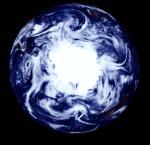
The December solstice brings the beginning of Winter to Earth's Northern Hemisphere and Summer time to the South! This view of Earth's Southern Hemisphere near the beginning of Summer was created using images from the Galileo spacecraft taken during its December 1990 flyby of our fair planet.
 Space Station Shows Off New Robot Arm
9.05.2001
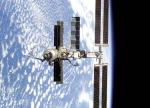
The International Space Station (ISS) continues to grow. Last month, the crew of the Space Shuttle Endeavor delivered new Logistics Modules and installed the new Canadarm2 on the growing outpost. The ISS -- complete with its new arm -- was photographed 400 kilometers above planet Earth by the Space Shuttle Endeavor crew soon after they undocked.
 Galileo Demonstrates the Telescope
14.10.2001
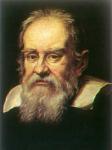
Galileo Galilei made a good discovery great. Upon hearing at age 40 that a Dutch optician had invented a glass that made distant objects appear larger, Galileo crafted his own telescope and turned it toward the sky.
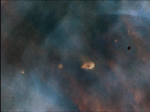 Proplyds: Infant Solar Systems?
17.10.1996
Are planets common in our galaxy? Strong evidence that the answer is "yes" was provided in this 1994 image made by the Hubble Space Telescope . A close-up of the Orion Nebulae, it reveals what seem to be disks of dust and gas surrounding newly formed stars.
|
January February March April May June July August September October |
|||||||||||||||||||||||||||||||||||||||||||||||||