
|
You entered: planet
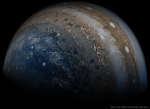 Beneath Jupiter
29.05.2017
Jupiter is stranger than we knew. NASA's Juno spacecraft has now completed its sixth swoop past Jupiter as it moves around its highly elliptical orbit. Pictured, Jupiter is seen from below where, surprisingly, the horizontal bands that cover most of the planet disappear into swirls and complex patterns.
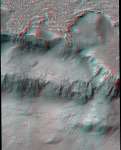 3D Lava Falls of Mars
1.07.2017
Get out your red/cyan glasses and gaze across lava falls of Mars. The stereo anaglyph was created by combining two images recorded by the HiRISE camera onboard Mars Reconnaissance Orbiter. The multi-level falls were...
 Sunset to Sunrise over the Baltic Sea
16.06.2023
This serene view from the coast of Sweden looks across the Baltic sea and compresses time, presenting the passage of one night in a single photograph. From sunset to sunrise, moonlight illuminates the creative sea and skyscape. Fleeting clouds, fixed stars, and flowing northern lights leave their traces in planet Earth's sky.
 A Solstice Sun Tattoo
20.12.2025
The word solstice is from the Latin for Sun and to pause or stand still. And in the days surrounding a solstice the Sun's annual north-south drift in planet Earth's sky does slow down, pause, and then reverse direction.
 Isaac Newton Explains the Solar System
23.07.2000
Sir Isaac Newton changed the world. Born in 1643, Newton was only an above-average student. But he went home from Cambridge one summer in 1665, thought a lot about the physical nature of the world, and came back two years later with a revolutionary understanding of mathematics, gravitation, and optics.
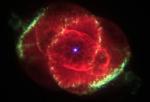 The Cat's Eye Nebula
2.08.1997
Three thousand light years away, a dying star throws off shells of glowing gas. This image from the Hubble Space Telescope reveals "The Cat's Eye Nebula" to be one of the most complex planetary nebulae known.
 The Cat's Eye Nebula
1.11.1998
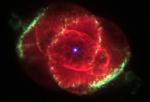
Three thousand light years away, a dying star throws off shells of glowing gas. This image from the Hubble Space Telescope reveals The Cat's Eye Nebula to be one of the most complex planetary nebulae known.
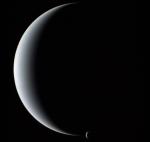 Crescent Neptune and Triton
18.06.2006
Gliding silently through the outer Solar System, the Voyager 2 spacecraft camera captured Neptune and Triton together in crescent phase in 1989. The above picture of the gas giant planet and its cloudy moon was taken from behind just after closest approach.
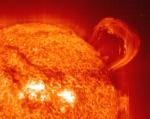 Equinox and Eruptive Prominence
23.09.1999
Today, the Sun crosses the celestial equator and seasons change from Summer to Fall in the north and Winter to Spring in the southern hemisphere. Defined by the Sun's position in sky the event is known as an equinox - the length of daylight is equal to the length of night.
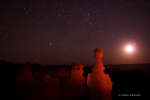 Hoodoo Sky
3.07.2008
The strange-looking rock formations in the foreground of this skyscape are called hoodoos. Towers of weathered, eroded sedimentary rock, hoodoos are found in arid regions of planet Earth and are particularly abundant in an area known as Bryce Canyon National Park in southern Utah, USA.
|
January February March April May June July August September October |
|||||||||||||||||||||||||||||||||||||||||||||||||