
|
You entered: planets
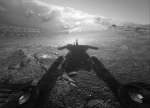 Shadow of a Martian Robot
8.05.2011
What if you saw your shadow on Mars and it wasn't human? Then you might be the Opportunity rover currently exploring Mars. Opportunity and sister robot Spirit have been probing the red planet since early 2004, finding evidence of ancient water, and sending breathtaking images across the inner Solar System.
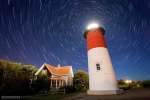 Nauset Light Star Trails
10.10.2012
In myth, Atlas holds up the heavens, but in this scene they seem to pivot around a lighthouse beacon. Photographed with a camera fixed to a tripod, the well-planned 30 minute exposure records star trails in the northern sky, reflecting the daily rotation of planet Earth.
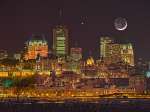 Moon Venus Mars Skyline
27.02.2015
Taken on February 20, five different exposures made in rapid succession were used to created this tantalizing telephoto image. In combination, they reveal a wide range of brightness visible to the eye on that frigid evening, from the urban glow of the Quebec City skyline to the triple conjunction of Moon, Venus and Mars.
 Across the Sun
30.04.2015
A long solar filament stretches across the relatively calm surface of the Sun in this telescopic snap shot from April 27. The negative or inverted narrowband image was made in the light of ionized hydrogen atoms.
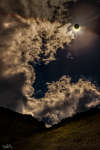 Reunion Island Eclipse
3.09.2016
The New Moon's dark shadow crossed planet Earth on September 1. In silhouette the Moon didn't quite cover the Sun though, creating an an annular solar eclipse. The shadow's narrow central path was about 100 kilometers wide at maximum eclipse.
 Shadow Rise on the Inside Passage
5.07.2018
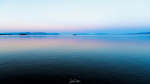
At sunset look east not west. As Earth's dark shadow rises from the eastern horizon, faint and subtle colors will appear opposite the setting Sun. This beautiful evening sea and skyscape records the reflective scene from a cruise on the well-traveled Alaskan Inside Passage in the Pacific Northwest.
 Centaurus A
12.07.2018
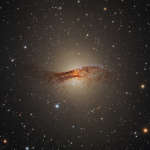
Only 11 million light-years away, Centaurus A is the closest active galaxy to planet Earth. Spanning over 60,000 light-years, the peculiar elliptical galaxy also known as NGC 5128, is featured in this sharp telescopic view.
 Partial Eclipse over Beijing
11.01.2019
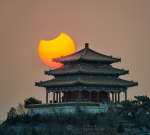
On January 6 the New Moon rose in silhouette with the Sun seen from northeastern Asia. Near maximum, the dramatic partial solar eclipse is captured in this telephoto view through hazy skies. In the foreground, the hill top Wanchun pavilion overlooking central Beijing's popular Forbidden City hosts eclipse-watching early morning risers.
 Working in Space
29.05.2001
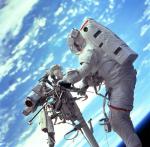
High above planet Earth, a human helps an ailing machine. The machine, in this potentially touching story, is the Hubble Space Telescope, which is not in the picture. The human is Astronaut Steven L.
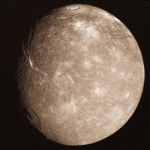 Uranus' Largest Moon: Titania
4.03.1996
Titania's tortured terrain is a mix of valleys and craters. NASA's interplanetary robot spacecraft Voyager 2 passed this moon of Uranus in 1986 and took the above photograph. The photograph was then transmitted back to earth by radio.
|
January February March April May June July August September October |
|||||||||||||||||||||||||||||||||||||||||||||||||