
|
You entered: planets
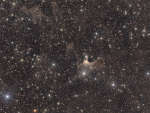 Haunting the Cepheus Flare
30.10.2008
Spooky shapes seem to haunt this starry expanse, drifting through the night in the royal constellation Cepheus. Of course, the shapes are cosmic dust clouds faintly visible in dimly reflected starlight. Far from your...
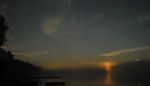 The Sky in Motion
31.12.2008
Still need to come up with a good new year's resolution? Consider one appropriate for 2009, the International Year of Astronomy; just look up -- experience, learn, and enjoy the changing sky. This 4-minute, time-lapse video is composed from a series of 7,000 images highlighting much of what you could see.
 Bonestell Panorama from Mars
20.01.2009
If you could stand on Mars -- what could you see? One memorable vista might be the above 360-degree panoramic image taken by the robotic Spirit rover over the last year. The above image involved over 200 exposures and was released as part of Spirit's five year anniversary of landing on the red planet.
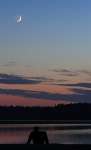 Calm, Crescent Moon, and Venus
21.05.2010
Last weekend, the Moon and Venus formed a beautiful close pair in the west after sunset, a scene enjoyed by skygazers all over the world. In this lovely view of the conjunction from Sweden, a calm lake Vallentuna lies in the foreground with sunset colors still fading behind the treeline on the far shore.
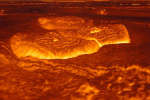 Venus Once Molten Surface
1.08.2010
If you could look across Venus with radar eyes, what might you see? This computer reconstruction of the surface of Venus was created from data from the Magellan spacecraft. Magellan orbited Venus and used radar to map our neighboring planet's surface between 1990 and 1994.
 October Skylights
28.10.2011
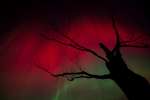
As northern hemisphere nights grow longer, October is a good month for spotting auroras, or even other eerie apparitions after dark. And this week the night sky did not disappoint. On October 24th a solar coronal mass ejection impacted planet Earth's magnetosphere triggering far ranging auroral displays.
 Venus Once Molten Surface
23.06.2013
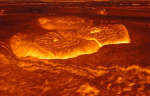
If you could look across Venus with radar eyes, what might you see? This computer reconstruction of the surface of Venus was created from data from the Magellan spacecraft. Magellan orbited Venus and used radar to map our neighboring planet's surface between 1990 and 1994.
 Strawberry to Honey Moonrise
25.06.2016
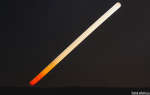
Near the horizon the Full Moon often seems to loom large, swollen in appearance by the famous Moon illusion. But timelapse images demonstrate that the Moon's apparent size doesn't really change as it climbs toward the zenith. Its color does, though.
 Noctilucent NEOWISE
9.07.2020
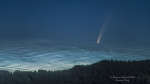
These silvery blue waves washing over a tree-lined horizon in the eastern French Alps are noctilucent clouds. From high in planet Earth's mesosphere, they reflect sunlight in this predawn skyscape taken on July 8. This summer, the night-shining clouds are not new to the northern high-latitudes. Comet NEOWISE is though.
 A Star Cluster in Motion
30.07.2002
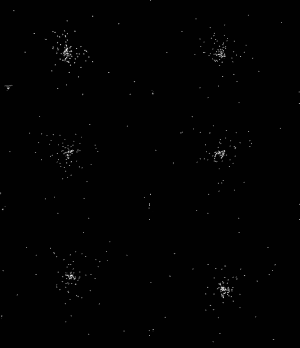
Star clusters are a swarm of complex motions. The stars that compose globular clusters and many open clusters all orbit the cluster center, occasionally interacting, gravitationally, with a close-passing star. The orbits of stars around the cluster are typically not as circular as the orbits of planets in our solar system.
|
January February March April May June July August September October |
|||||||||||||||||||||||||||||||||||||||||||||||||