
|
You entered: planets
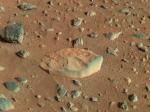 White Boat Rock on Mars
25.02.2004
What caused this rock to have an unusual shape? Earlier this month the robot Spirit rover on Mars stopped to examine a rock dubbed "white boat", named for its unusually light color and shape.
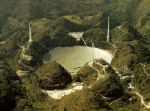 Arecibo: The Largest Telescope
29.11.1998
The Arecibo radio telescope is currently the largest single-dish telescope in the world. First opening in 1963, this 305 meter (1000 foot) radio telescope resides in a natural valley of Puerto Rico. The Arecibo telescope has been used for many astronomical research projects, including
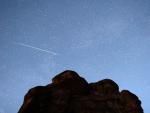 Comet Dust over Colorado
17.08.2006
The rock formation in the foreground of this night view was recorded on August 10, illuminated by light from a waning gibbous Moon. Even though the sky above also scatters the bright moonlight, a brilliant meteor was captured as it flashed across the scene during the 30 second long exposure.
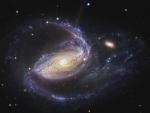 In the Arms of NGC 1097
1.12.2006
A smaller companion seems wrapped in the spiral arms of enigmatic galaxy NGC 1097. This amazingly deep image of the peculiar spiral system, also known as Arp 77, actually combines data from two telescopes, one in the northern and one in the southern hemisphere of planet Earth.
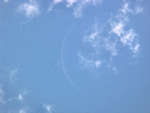 Crescent Venus and Moon
16.05.2010
There's something behind these clouds. Those faint graceful arcs, upon inspection, are actually far, far in the distance. They are the Earth's Moon and the planet Venus. Both the Moon and Venus are bright enough to be seen during the day, and both are quite capable of showing a crescent phase.
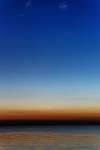 Dawn s Grande Finale
4.06.2011
After more than a month, the lovely lineup of four naked-eye planets in dawn skies is coming to a close. Still, on May 31st a slender Moon joined the grouping along the eastern horizon for a final celestial performance, presented in this early morning scene from a beach near Buenos Aires, Argentina.
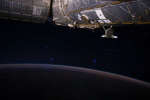 Orion Arising
28.06.2014
Orion's belt runs just along the horizon, seen through Earth's atmosphere and rising in this starry snapshot from low Earth orbit on board the International Space Station. The belt stars, Alnitak, Alnilam...
 ISS Fisheye Flythrough
5.11.2016
Shot in Ultra HD, this stunning video can take you on a tour of the International Space Station. A fisheye lens with sharp focus and extreme depth of field provides an immersive visual experience of life in the orbital outpost.
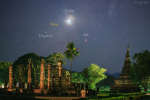 Nova over Thailand
21.11.2016
A nova in Sagittarius is bright enough to see with binoculars. Detected last month, the stellar explosion even approached the limit of naked-eye visibility last week. A classical nova results from a thermonuclear explosion...
 Bow Tie Moon and Star Trails
8.02.2018
On January 31, a leisurely lunar eclipse was enjoyed from all over the night side of planet Earth, the first of three consecutive total eclipses of the Moon. This dramatic time-lapse image followed the celestial performance for over three hours in a combined series of exposures from Hebei Province in Northern China.
|
January February March April May June July August September October |
|||||||||||||||||||||||||||||||||||||||||||||||||