
|
You entered: planets
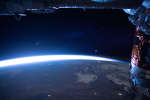 Comet NEOWISE from the ISS
10.07.2020
Rounding the Sun on July 3rd and currently headed for the outer Solar System, Comet NEOWISE (C/2020 F3) has been growing brighter in the predawn skies of planet Earth. From low Earth orbit...
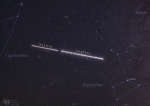 Saturn and Jupiter in Summer 2020
12.12.2020
During this northern summer Saturn and Jupiter were both near opposition, opposite the Sun in planet Earth's sky. Their paired retrograde motion, seen about every 20 years, is followed from 19 June through 28 August in this panoramic composite as they wander together between the stars in western Capricornus and eastern Sagittarius.
 Artemis 1: Flight Day 13
30.11.2023
On flight day 13 (November 28, 2022) of the Artemis I mission, the Orion spacecraft reached its maximum distance from its home world. Over 430,000 kilometers from Earth in a distant retrograde orbit, Orion surpassed the record for most distant spacecraft designed to carry humans.
 APOD: 2024 November 10 Б Valles Marineris: The Grand Canyon of Mars
10.11.2024
The largest canyon in the Solar System cuts a wide swath across the face of Mars. Named Valles Marineris, the grand valley extends over 3,000 kilometers long, spans as much as 600 kilometers across, and delves as much as 8 kilometers deep.
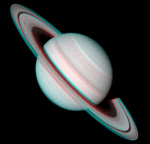 Stereo Saturn
29.10.1997
Get out your red/blue glasses and launch yourself into this stereo picture of Saturn! The picture is actually composed from two images recorded weeks apart by the Voyager 2 spacecraft during its visit to the Saturnian System in August of 1981.
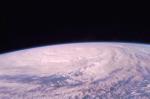 Super Typhoon Winnie
19.08.1997
Super Typhoon Winnie raged through parts of the Eastern Hemisphere last week. Swirling in the Pacific Ocean with winds in excess of 160 miler per hour, Winnie became one of the stronger storm systems in modern times: a Category 5 Hurricane.
 Hamlet of Oberon
31.01.1998
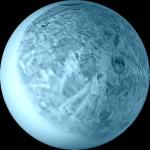
What's in a name? Since 1919, the International Astronomical Union has been charged with the task of establishing "conventional" nomenclature for planets, satellites, and surface features. For the remote Uranian system of moons, namesakes from Shakespearean works have been chosen.
 Melas Chasma
29.07.2004
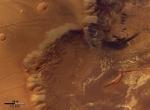
Steep cliffs drop into the rugged terrain of Melas Chasma in this stunning view from the Mars Express spacecraft orbiting the Red Planet. At a scale of 16 meters per pixel, the image data...
 Saturn from Earth
2.09.1998
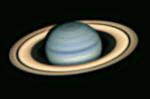
Saturn is the second largest planet in our Solar System. Saturn has been easily visible in the sky since history has been recorded. Galileo used one of the first telescopes in 1610 to discover Saturn's rings, which he first thought were moons.
 Eclipse with Lighthouse
10.03.2007
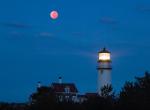
A red Moon rose over Cape Cod, Massachusetts, USA on March 3rd, immersed in Earth's shadow near the total phase of a lunar eclipse. This serene portrait of the eclipsed Moon in a dark blue twilight sky also features the Highland Lighthouse (aka Cape Cod lighthouse), another more locally familiar beacon in the night.
|
January February March April May June July August September October |
|||||||||||||||||||||||||||||||||||||||||||||||||