
|
You entered: planets
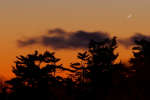 A New Year s Crescent
1.01.2014
That's not the young crescent Moon poised above the western horizon at sunset. Instead it's Venus in a crescent phase, captured with a long telephoto lens from Quebec City, Canada, planet Earth on a chilly December 30th evening. The very bright celestial beacon is droping lower into the evening twilight every day.
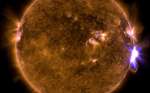 Flare Well AR2673
14.09.2017
Almost out of view from our fair planet, rotating around the Sun's western edge giant active region AR2673 lashed out with another intense solar flare followed by a large coronal mass ejection on September 10.
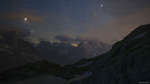 Eclipsed Moon and Mars over Mountains
7.08.2018
There is something unusual about this astronomically-oriented photograph. It's not obvious -- it was discovered only during post-processing. It is not the Moon, although capturing the Moon rising during a total lunar eclipse is quite an unusually interesting sight.
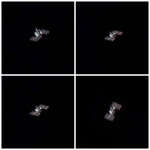 ISS from Wallasey
6.04.2019
After sunset on March 28, the International Space Station climbed above the western horizon, as seen from Wallasey, England at the mouth of the River Mersey. Still glinting in the sunlight some 400 kilometers...
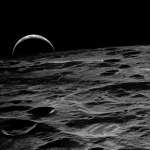 Apollo 14 Heads for Home
1.02.2020
When leaving lunar orbit in February 1971, the crew of Apollo 14 watched this Earthrise from their command module Kittyhawk. With Earth's sunlit crescent just peaking over the lunar horizon, the cratered terrain in the foreground is along the lunar farside.
 Ring of Fire over Monument Valley
5.10.2023
Tracking along a narrow path, the shadow of a new moon will race across North, Central, and South America, on October 14. When viewed from the shadow path the apparent size of the lunar disk will not quite completely cover the Sun though.
 Comet G3 ATLAS: a Tail and a Telescope
24.01.2025
Comet C/2024 G3 ATLAS has made a dramatic appearance in planet Earth's skies. A visitor from the distant Oort Cloud, the comet reached its perihelion on January 13. On January 19, the bright comet was captured here from ESO Paranal Observatory in the Atacama desert in Chile.
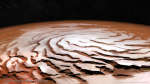 APOD: 2025 July 6 Б The Spiral North Pole of Mars
6.07.2025
Why is there a spiral around the North Pole of Mars? Each winter this pole develops a new outer layer about one meter thick composed of carbon dioxide frozen out of the thin Martian atmosphere. This fresh layer is deposited on a water-ice layer that exists year round.
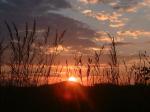 Zimbabwe Sunset
21.06.2002
Today's scheduled geocentric astronomical event is the Solstice, with the Sun reaching its northernmost declination at 13 hours 24 minutes Universal Time. For denizens of planet Earth this Solstice marks the begining of Summer in the northern hemisphere and Winter in the south.
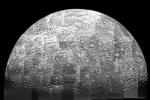 Outbound from Mercury
16.07.2002
After just passing Mercury, the robot spacecraft Mariner 10 looked back. The above picture is what it saw. Mercury, the closest planet to the Sun, is heavily cratered much like Earth's Moon.
|
January February March April May June July August September October |
|||||||||||||||||||||||||||||||||||||||||||||||||