
|
You entered: planets
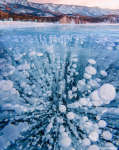 Methane Bubbles Frozen in Lake Baikal
18.12.2018
What are these bubbles frozen into Lake Baikal? Methane. Lake Baikal, a UNESCO World Heritage Site in Russia, is the world's largest (by volume), oldest, and deepest lake, containing over 20% of the world's fresh water.
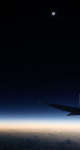 8 Minute and 30 Second Eclipse
6.07.2019
The total phase of the July 2nd solar eclipse lasted about 4 minutes and 30 seconds at the point of maximum eclipse. On the surface of planet Earth, that was about 600 nautical miles north of Easter Island in the Southern Pacific Ocean.
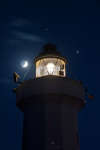 Great Conjunction over Sicilian Lighthouse
8.12.2020
DonБt miss the coming great conjunction. In just under two weeks, the two largest planets in our Solar System will angularly pass so close together in Earth's sky that the Moon would easily be able to cover them both simultaneously. This pending planetary passage -- on December 21 -- will be the closest since 1623.
 183 Days in the Sun
22.12.2023
A single 183 day exposure with a pinhole camera and photographic paper resulted in this long-duration solargraph. Recorded from solstice to solstice, June 21 to December 21, in 2022, it follows the Sun's daily arcing path through planet Earth's skies from Mertola, Portugal.
 A Gargoyles Eclipse
5.04.2025
In dramatic silhouette against a cloudy daytime sky over Paris, France, gargoyles cast their monstrous gaze outward from the west facade of Notre Dame Cathedral. Taken on March 29, this telephoto snapshot also captures the dramatic silhouette of a New Moon against the bright solar disk in a partial solar eclipse.
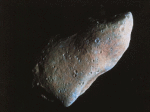 Asteroid Gaspra's Best Face
20.10.1995
Above is the best yet color image of the asteroid Gaspra based on data returned by NASA's Galileo spacecraft. Color variations have been added to high resolution images and enhanced to highlight changes in reflectivity, surface structure and composition. The illuminated portion of the asteroid is about 11 miles long.
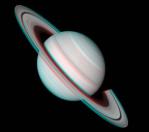 Stereo Saturn
7.09.2002
Get out your red/blue glasses and launch yourself into this stereo picture of Saturn! The picture is actually composed from two images recorded weeks apart by the Voyager 2 spacecraft during its visit to the Saturnian System in August of 1981.
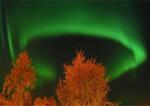 Aurora s Ring
15.10.2002
Gusting solar winds and blasts of charged particles from the Sun made the early days of October rewarding ones for those anticipating aurora. While out enjoying the stormy space weather from Toemmeraas, Norway, Trygve Lindersen recorded this picturesque apparition of the northern lights with a digital camera on October 6.
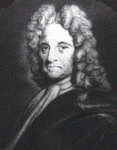 Edmund Halley's Greatest Discoveries
6.07.1996
Sir Edmond Halley was quite a discoverer. Born in 1656, he computed in 1705 that a bright comet was periodic and would make another appearance in 1758. The comet appeared as predicted and is now known as Comet Halley. Unfortunately, Halley died in 1742 and never saw his prediction come true.
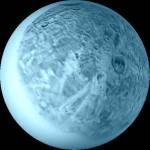 Hamlet of Oberon
27.02.1999
What's in a name? Since 1919, the International Astronomical Union has been charged with the task of establishing "conventional" nomenclature for planets, satellites, and surface features. For the remote Uranian system of moons, namesakes from Shakespearean works have been chosen.
|
January February March April May June July August September October |
|||||||||||||||||||||||||||||||||||||||||||||||||