
|
You entered: planets
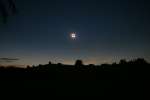 Eclipse over the Great Wall
31.08.2008
Contrary to the famous myth, you can't see the Great Wall of China from the Moon ... even during a total solar eclipse. But on August 1 you could see the Moon eclipsing the Sun from the Great Wall.
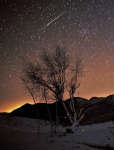 A Meteor Moment
17.12.2010
Intensely bright, this fireball meteor flashed through Tuesday's cold, clear, early morning skies over the Karakas Mountains in central Iran, near the peak of the annual Geminid Meteor Shower. To capture the meteor moment and wintery night skyscape, the photographer's camera was fixed to a tripod, its shutter open for about 1.5 minutes.
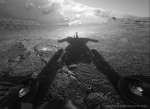 Shadow of a Martian Robot
28.03.2015
What if you saw your shadow on Mars and it wasn't human? Then you might be the Opportunity rover currently exploring Mars. Opportunity has been exploring the red planet since early 2004, finding evidence of ancient water, and sending breathtaking images across the inner Solar System.
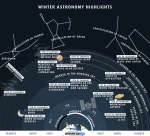 Highlights of the Winter Sky
12.12.2017
What's up in the sky this winter? The featured graphic gives a few highlights for Earth's northern hemisphere. Viewed as a clock face centered at the bottom, early winter sky events fan out toward the left, while late winter events are projected toward the right.
 The Moona Lisa
16.10.2021
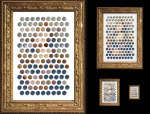
Only natural colors of the Moon in planet Earth's sky appear in this creative visual presentation. Arranged as pixels in a framed image, the lunar disks were photographed at different times. Their varying hues are ultimately due to reflected sunlight affected by changing atmospheric conditions and the alignment geometry of Moon, Earth, and Sun.
 Gemind of the North
17.12.2021
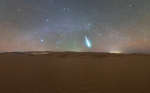
An arid expanse of the Tengger Desert in north-central China, planet Earth fills the foreground of this starry scene. A widefield panoramic view, it was recorded shortly after moonset in the local predawn hours of December 14. Pictured in the still dark sky, stars of the northern winter hexagon surround a luminous Milky Way.
 Naked Eye Comet ZTF
21.01.2023
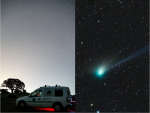
Comet C/2022E3 (ZTF) is no longer too dim to require a telescope for viewing. By January 19, it could just be seen with the naked eye in this rural sky with little light pollution from a location about 20 kilometers from Salamanca, Spain.
 The Moona Lisa
14.09.2024
Only natural colors of the Moon in planet Earth's sky appear in this creative visual presentation. Arranged as pixels in a framed image, the lunar disks were photographed at different times. Their varying hues are ultimately due to reflected sunlight affected by changing atmospheric conditions and the alignment geometry of Moon, Earth, and Sun.
 Moon Near the Edge
12.04.2025
Most of us watch the Moon at night. But the Moon spends nearly as many daylight hours above our horizon, though in bright daytime skies the lunar disk looks pale and can be a little harder to see.
 Aristarchus' Unbelievable Discoveries
14.09.1996
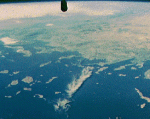
Here lived one of the greatest thinkers in human history. Aristarchus lived on the Greek island of Samos, a small island in the center of the above picture that can be identified with a good map.
|
January February March April May June July August September October |
|||||||||||||||||||||||||||||||||||||||||||||||||