
|
You entered: planets
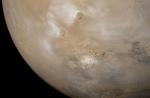 The Fogs of Mars
2.06.2003
Fogs of clouds and dust covered parts of southern Mars during last Martian winter. Giant volcanoes, such as Ascraeus Mons, the central circular feature near the top of the image, were surrounded by large water clouds. Slightly southwest, Pavonis Mons and Arisa Mons also peeked above their water clouds.
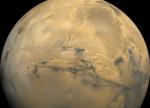 Valles Marineris: The Grand Canyon of Mars
24.08.2003
The largest canyon in the Solar System cuts a wide swath across the face of Mars. Named Valles Marineris, the grand valley extends over 3,000 kilometers long, spans as much as 600 kilometers across, and delves as much as 8 kilometers deep.
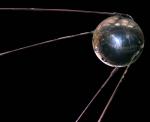 50th Anniversary of Sputnik: Traveling Companion
4.10.2007
Sputnik means "traveling companion". Despite the innocuous sounding name, the launch of planet Earth's first artificial moon, Sputnik 1, by the Soviet Union on October 4, 1957, changed the world and set in motion events which resulted in the creation of NASA and the race to the Moon.
 Moon and Morning Star
24.04.2009
Wednesday, the Moon and Venus rose together in early morning skies. Even through clouds, both show off a lovely crescent in this well-composed skyscape from Rutherford College, North Carolina, in the eastern US. Farther west, North American skygazers could also witness the Moon passing in front of Venus.
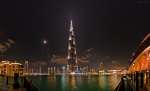 Starry Night over Dubai
16.07.2011
A starry night over the city of Dubai in the United Arab Emirates is really not so starry. In fact, the Moon is the only celestial beacon to come close to competing with city lights in this night skyscape, a situation all too familiar to urban skygazers.
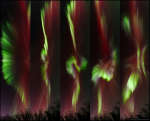 Alaska Aurora Sequence
28.12.2013
A remarkably intense auroral band flooded the northern night with shimmering colors on December 7. The stunning sequence captured here was made with a camera fixed to a tripod under cold, clear skies near Ester, just outside of Fairbanks, Alaska.
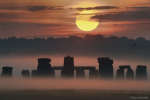 Sunrise Solstice over Stonehenge
19.06.2016
Today the Sun reaches its northernmost point in planet Earth's sky. Called a solstice, the date traditionally marks a change of seasons -- from spring to summer in Earth's Northern Hemisphere and from fall to winter in Earth's Southern Hemisphere.
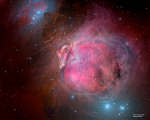 The Great Turkey Nebula
25.11.2020
Surprisingly reminiscent of The Great Nebula in Orion, The Great Turkey Nebula spans this creative field of view. Of course if it were the Orion Nebula it would be our closest large stellar nursery, found at the edge of a large molecular cloud a mere 1,500 light-years away.
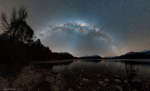 Galaxy by the Lake
9.09.2022
This 180 degree panoramic night skyscape captures our Milky Way Galaxy as it arcs above the horizon on a winter's night in August. Near midnight, the galactic center is close to the zenith with the clear waters of Lake Traful, Neuquen, Argentina, South America, planet Earth below.
 Comet Pons-Brooks at Night
3.04.2024
In dark evening skies over June Lake, northern hemisphere, planet Earth, Comet 12P/Pons-Brooks stood just above the western horizon on March 30. Its twisted turbulent ion tail and diffuse greenish coma are captured in this two degree wide telescopic field of view along with bright yellowish star Hamal also known as Alpha Arietis.
|
January February March April May June July August September October |
|||||||||||||||||||||||||||||||||||||||||||||||||