
|
You entered: telescope
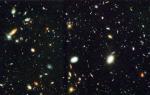 The Hubble Deep Field
9.07.2000
Galaxies like colorful pieces of candy fill the Hubble Deep Field - one of humanity's most distant optical views of the Universe. The dimmest, some as faint as 30th magnitude (about four billion times...
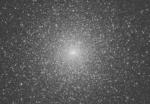 Globular Cluster M15
10.12.2001
Stars, like bees, swarm around the center of bright globular cluster M15. This ball of over 100,000 stars is a relic from the early years of our Galaxy, and continues to orbit the Milky Way's center.
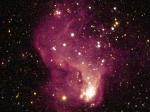 Star Forming Region Hubble V
25.12.2001
How did stars form in the early universe? Astronomers are gaining insight by studying NGC 6822, a nearby galaxy classified as irregular by modern standards but appearing more typical of galaxies billions of years ago. Inspection of NGC 6822 shows several bright star groups, including two dubbed Hubble-X and Hubble-V.
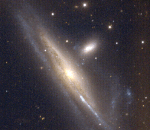 Interacting Galaxies
10.07.1998
This dramatic image of an interacting pair of galaxies was made using the 1.5 meter telescope at the Cerro Tololo Inter-American Observatory near La Serena, Chile. NGC 1531 is the background galaxy with a bright core just above center and NGC 1532 is the foreground spiral galaxy laced with dust lanes.
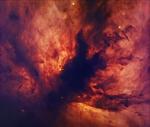 Flame Nebula Close Up
2.02.2007
Of course, the Flame Nebula is not on fire. Also known as NGC 2024, the nebula's suggestive reddish color is due to the glow of hydrogen atoms at the edge of the giant Orion molecular cloud complex some 1,500 light-years away.
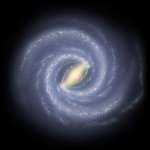 Two Armed Spiral Milky Way
6.06.2008
Gazing out from within the Milky Way, our own galaxy's true structure is difficult to discern. But an ambitious survey effort with the Spitzer Space Telescope now offers convincing evidence that we live...
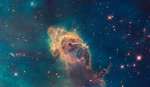 Carina Pillar and Jets
1.10.2009
This cosmic pillar of gas and dust is nearly 2 light-years wide. The structure lies within one of our galaxy's largest star forming regions, the Carina Nebula, shining in southern skies at a distance of about 7,500 light-years.
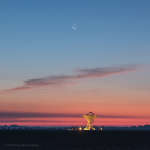 Moon, Mercury, and Twilight Radio
8.10.2016
Sharing dawn's twilight with the Moon on September 29, Mercury was about as far from the Sun as it can wander, the innermost planet close to its maximum elongation in planet Earth's skies.
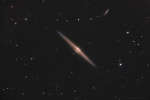 NGC 4565: Galaxy on Edge
22.02.2019
Magnificent spiral galaxy NGC 4565 is viewed edge-on from planet Earth. Also known as the Needle Galaxy for its narrow profile, bright NGC 4565 is a stop on many telescopic tours of the northern sky, in the faint but well-groomed constellation Coma Berenices.
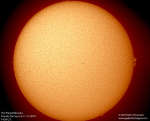 Mercury and the Quiet Sun
14.11.2019
On November 11, 2019 the Sun was mostly quiet, experiencing a minimum in its 11 year cycle of activity. In fact, the only spot visible was actually planet Mercury, making a leisurely 5 1/2 hour transit in front of the calm solar disk.
|
January February March April May June July August September October |
|||||||||||||||||||||||||||||||||||||||||||||||||