
|
You entered: telescope
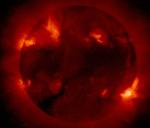 Solstice Sun In Soft X-rays
21.12.1998
The solstice occurs today at 8:56 PM Eastern Standard Time. At the solstice the sun reaches its most southerly position in the sky and winter begins for the Northern Hemisphere while summer starts South of the Equator.
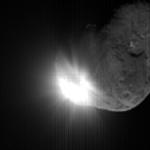 Thirteen Seconds After Impact
5.07.2005
Fireworks came early on July 4th when, at 1:52am EDT, the Deep Impact spacecraft's probe smashed into the surface of Comet Tempel 1's nucleus at ten kilometers per second. The well-targeted impactor probe was vaporized as it blasted out an expanding cloud of material, seen here 13 seconds after the collision.
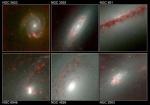 An Infrared Galaxy Gallery
22.03.1999
Where do stars form in galaxies? One way to find this out it to look for glowing hydrogen, a material common to hot star-forming regions. To find large areas of glowing hydrogen, the Hubble Space Telescope's NICMOS instrument surveyed about 100 nearby spiral galaxies.
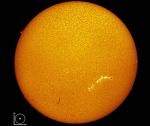 Simulated Transit of Mercury
8.11.2006
Mercury, the solar system's innermost planet, will spend about five hours crossing in front of the Sun today - beginning at 1912 UT (2:12pm EST), November 8. Specially equipped telescopes are highly recommended...
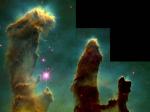 M16: Pillars of Creation
18.02.2007
It has become one of the most famous images of modern times. This image, taken with the Hubble Space Telescope in 1995, shows evaporating gaseous globules (EGGs) emerging from pillars of molecular hydrogen gas and dust.
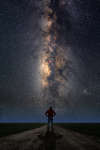 The Milky Road
13.06.2009
Inspired by the night skies of planet Earth in the International Year of Astronomy, photographer Larry Landolfi created this tantalizing fantasy view. The composited image suggests a luminous Milky Way is the heavenly extension of a country road.
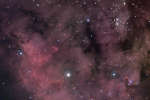 The Star Pillars of Sharpless 171
18.10.2009
Towering pillars of cold gas and dark dust adorn the center star forming region of Sharpless 171. An open cluster of stars is forming there from the gas in cold molecular clouds. As energetic...
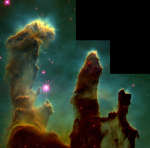 M16: Pillars of Creation
28.03.2010
It has become one of the most famous images of modern times. This image, taken with the Hubble Space Telescope in 1995, shows evaporating gaseous globules (EGGs) emerging from pillars of molecular hydrogen gas and dust.
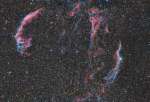 Wisps of the Veil Nebula
26.11.2012
Wisps like this are all that remain visible of a Milky Way star. About 9,000 years ago that star exploded in a supernova leaving the Veil Nebula, also known as the Cygnus Loop.
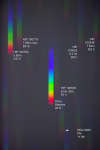 A Spectrum of Nova Delphini
23.08.2013
When a new star appeared in the constellation Delphinus late last week, astronomers found its spectrum hinted at the apparition's true nature. Now known as Nova Delphini, its visible light spectrum near maximum...
|
January February March April May June July August September October |
|||||||||||||||||||||||||||||||||||||||||||||||||