
|
You entered: telescope
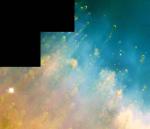 At the Edge of the Helix Nebula
12.05.2002
While exploring the inner edge of the Helix Nebula with the Hubble Space Telescope's Wide Field Planetary Camera 2, astronomers were able to produce this striking image - rich in details of an exotic environment.
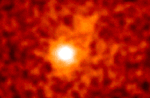 Gamma-Ray Quasars
22.10.1995
Gamma rays are more than 10,000 times more energetic than visible light. If you could "see" gamma rays, the night sky would seem very different indeed. The bright object in the center of the false color gamma-ray image above is quasar 3C279, a nondescript, faint, starlike object in the visible sky.
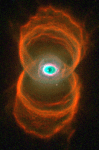 MyCn18: An Hourglass Nebula
17.01.1996
The sands of time are running out for the central star of this hourglass-shaped planetary nebula. With its nuclear fuel exhausted, this brief, spectacular, closing phase of a Sun-like star's life occurs as its outer layers are ejected - its core becoming a cooling, fading White Dwarf.
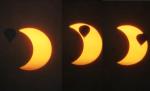 Sun, Moon, Hot Air Balloon
6.06.2003
Anticipating the celestial shadow play of a solar eclipse, sky gazers across Germany watched the Sun rise on May 31. In Bonn, astrophotographer Thilo Kranz had set up his small refractor telescope and camera on the Kennedy Bridge across the Rhein river to get a good view to the northeast.
 Three Dusty Stars
23.04.1998
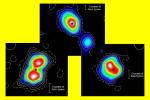
These separate radio images reveal three dusty debris disks surrounding three bright, young, nearby stars - evidence for solar systems in formation. From left to right are the stars Fomalhaut, Beta Pictoris, and Vega, their positions indicated by star symbols. The false color maps show the intensity of submillimeter radio emission from the surrounding dust.
 NGC4039: Starbirth and Galaxy Death
6.05.1997
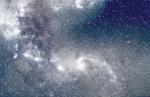
Do star clusters form when galaxies collide? Quite possibly, according to Hubble Space Telescope observations of the "Antennae", two galaxies thought to be in the early stages of a collision.
 IC 405: The Flaming Star Nebula
23.11.2003
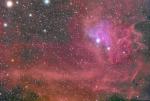
Rippling dust and gas lanes give the Flaming Star Nebula its name. The red and purple colors of the nebula are present in different regions and are created by different processes. The bright star...
 Cassiopeia A Light Echoes in Infrared
15.06.2005
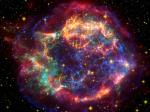
Why is the image of Cassiopeia A changing? Two images of the nearby supernova remnant taken a year apart in infrared light appear to show outward motions at tremendous speeds. This was unexpected since the supernova that created the picturesque nebula was seen 325 years ago. The reason is likely light echoes.
 The Star Pillars of Sharpless 171
27.09.2005
Towering pillars of cold gas and dark dust adorn the center star forming region of Sharpless 171. An open cluster of stars is forming there from the gas in cold molecular clouds. As energetic...
 V838 Mon: Echoes from the Edge
2.11.2006
Variable star V838 Monocerotis lies near the edge of our Milky Way Galaxy, about 20,000 light-years from the Sun. Still, ever since a sudden outburst was detected in January 2002, this enigmatic star has taken the center of an astronomical stage.
|
January February March April May June July August September October |
|||||||||||||||||||||||||||||||||||||||||||||||||