
|
You entered: telescope
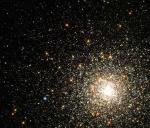 M80: A Dense Globular Cluster
7.07.1999
If our Sun were part of M80, the night sky would glow like a jewel box of bright stars. M80, also known as NGC 6093, is one of about 250 globular clusters that survive in our Galaxy.
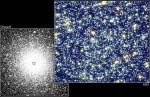 Blue Stagglers in Globular Clusters
4.11.1997
This old dog is doing new tricks. On the left is ancient globular cluster 47 Tucanae which formed many billions of years ago. On the right is a closeup of its dense stellar center by the Hubble Space Telescope, released last week.
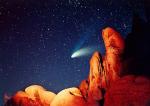 A Farewell to Tails
15.12.1997
As 1997 fades, so does the Great Comet of 1997: Comet Hale-Bopp. Discovered even before the Great Comet of 1996, Comet Hale-Bopp became the brightest comet since 1976. Many will remember Comet Hale-Bopp as a comet with a coma so bright it could be seen by eye even when near the Moon.
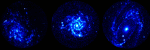 A Spiral Galaxy Gallery
14.03.1998
A progression of beautiful spiral galaxies is illustrated above with three photographs from NASA's Ultraviolet Imaging Telescope (UIT). Flying above the Earth's obscuring layer of atmosphere on the Space Shuttle Columbia during...
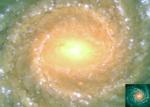 Spiral Galaxy NGC 1232
30.09.1998
Galaxies are fascinating not only for what is visible, but for what is invisible. Grand spiral galaxy NGC 1232, recently captured in detail by the new Very Large Telescope, is a good example.
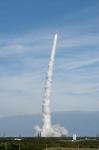 Swift Launches
22.11.2004
Where do gamma ray bursts occur? To help find out, NASA launched the Swift satellite on Saturday, as pictured above. What Swift is designed to do better than any previous satellite is to quickly locate these enigmatic explosions in both sky position and distance.
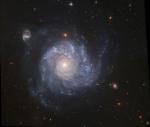 NGC 1309 and Friends
9.02.2006
A gorgeous spiral galaxy some 100 million light-years distant, NGC 1309 lies on the banks of the constellation Eridanus. NGC 1309 spans about 30,000 light-years, one third the size of our larger Milky Way galaxy.
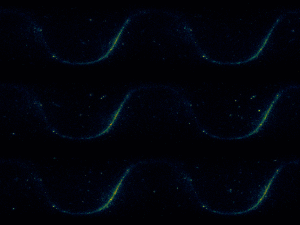 Simulated Gamma ray Sky
31.05.2006
Scheduled for launch in 2007, the Gamma-ray Large Area Space Telescope (GLAST) will explore the Universe in gamma-rays, the most energetic form of light. To get ready, consider this dynamic gamma-ray sky animation - constructed from simulating the first 55 days (seen above at one frame per day) of GLAST observations of cosmic gamma-ray sources.
 Ultraviolet Andromeda
17.09.2009
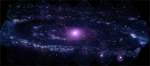
Taken by a telescope onboard NASA's Swift satellite, this stunning vista represents the highest resolution image ever made of the Andromeda Galaxy (aka M31) - at ultraviolet wavelengths. The mosaic is composed of 330 individual images covering a region 200,000 light-years wide.
 Giant Dust Ring Discovered Around Saturn
13.10.2009
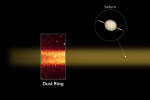
What has created a large dust ring around Saturn? At over 200 times the radius of Saturn and over 50 times the radius of Saturn's expansive E ring, the newly discovered dust ring is the largest planetary ring yet imaged. The ring was found in infrared light by the Earth-orbiting Spitzer Space Telescope.
|
January February March April May June July August September October |
|||||||||||||||||||||||||||||||||||||||||||||||||