
|
You entered: telescope
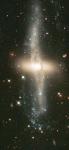 Polar Ring Galaxy NGC 4650A
10.05.1999
NGC 4650A appears to be two galaxies in one. A rare type of galaxy known as a Polar Ring, NGC 4650A is composed of an old central group of stars and a young ring of stars rotating farther out. Both components are clearly visible in this featured photograph by the Hubble Space Telescope.
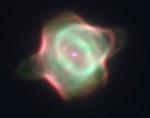 Hen 1357: New Born Nebula
6.10.2001
This Hubble Space Telescope snapshot shows Hen-1357, the youngest known planetary nebula. Graceful, gentle curves and symmetry suggest its popular name - The Stingray Nebula. Observations in the 1970s detected no nebular material, but this image from March 1996 clearly shows the Stingray's emerging bubbles and rings of shocked and ionized gas.
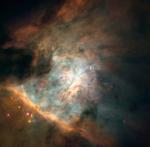 M42: A Mosaic of Orion's Great Nebula
22.05.1999
The Great Nebula in Orion, an immense, nearby starbirth region, is probably the most famous of all astronomical nebulae. Here, 15 pictures from the Hubble Space Telescope have been mosaicked to cover the inner 2.5 light years of the nebula and illustrate its diverse nature.
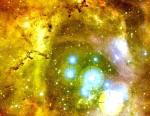 In the Center of the Rosette Nebula
29.04.2003
In the heart of the Rosette Nebula lies a bright open cluster of stars that lights up the nebula. The stars of NGC 2244 formed from the surrounding gas only a few million years ago. This just-released image taken by the CFHT's new MegaPrime camera shows the region in unprecedented detail.
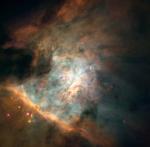 M42: A Mosaic of Orion's Great Nebula
11.05.1997
The Great Nebula in Orion, an immense, nearby starbirth region, is probably the most famous of all astronomical nebulae. Here, 15 pictures from the Hubble Space Telescope have been mosaicked to cover the inner 2.5 light years of the nebula and illustrate its diverse nature.
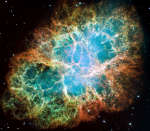 M1: The Crab Nebula from Hubble
25.12.2011
This is the mess that is left when a star explodes. The Crab Nebula, the result of a supernova seen in 1054 AD, is filled with mysterious filaments. The filaments are not only tremendously complex, but appear to have higher speed than expected from a free explosion.
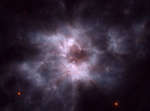 NGC 2440: Pearl of a New White Dwarf
17.05.2015
Like a pearl, a white dwarf star shines best after being freed from its shell. In this analogy, however, the Sun would be a mollusk and its discarded hull would shine prettiest of all!
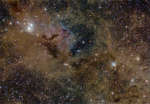 Stardust in Perseus
10.10.2015
This cosmic expanse of dust, gas, and stars covers some 6 degrees on the sky in the heroic constellation Perseus. At upper left in the gorgeous skyscape is the intriguing young star cluster IC 348 and neighboring Flying Ghost Nebula.
 The Keyhole in the Carina Nebula
14.08.2016
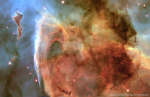
The dark dusty Keyhole Nebula gets its name from its unusual shape. The looping Keyhole, in this featured classic image by the Hubble Space Telescope, is a smaller region inside the larger Carina Nebula.
 The Lively Center of the Lagoon Nebula
1.06.2020
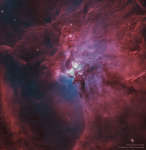
The center of the Lagoon Nebula is a whirlwind of spectacular star formation. Visible near the image center, at least two long funnel-shaped clouds, each roughly half a light-year long, have been formed by extreme stellar winds and intense energetic starlight. A tremendously bright nearby star, Hershel 36, lights the area.
|
January February March April May June July August September October |
|||||||||||||||||||||||||||||||||||||||||||||||||