
|
You entered: telescope
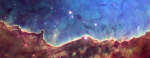 Dust Mountains in the Carina Nebula
7.10.2008
Bright young stars sometimes sculpt picturesque dust mountains soon after being born. Created quite by accident, the energetic light and winds from these massive newborn stars burn away accumulations of dark dust and cool gas in a slow but persistent manner.
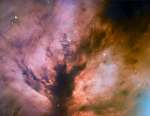 Flame Nebula Close Up
26.11.2010
Of course, the Flame Nebula is not on fire. Also known as NGC 2024, the nebula's suggestive reddish color is due to the glow of hydrogen atoms at the edge of the giant Orion molecular cloud complex some 1,500 light-years away.
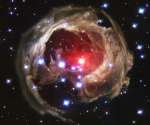 Light Echoes from V838 Mon
4.12.2011
For reasons unknown, star V838 Mon's outer surface suddenly greatly expanded with the result that it became the brightest star in the entire Milky Way Galaxy in January 2002. Then, just as suddenly, it faded. A stellar flash like this has never been seen before.
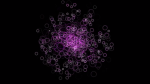 Gamma ray Rain from 3C 279
22.07.2015
If gamma-rays were raindrops a flare from a supermassive black hole might look like this. Not so gently falling on the Fermi Gamma-ray Space Telescope from June 14 to June 16 the gamma-ray photons, with energies up to 50 billion electron volts, originated in active galaxy 3C 279 some 5 billion light-years away.
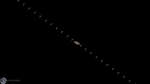 International Space Station Transits Saturn
22.01.2016
From low Earth orbit to the outer Solar System, this remarkable video frame composite follows the International Space Station's transit of Saturn. On January 15, the well-timed capture from a site near Dulmen, Germany required telescope and camera to be positioned along the predicted transit centerline, a path only 40 meters wide.
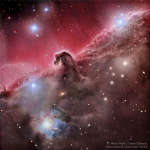 The Magnificent Horsehead Nebula
25.12.2016
Sculpted by stellar winds and radiation, a magnificent interstellar dust cloud by chance has assumed this recognizable shape. Fittingly named the Horsehead Nebula, it is some 1,500 light-years distant, embedded in the vast Orion cloud complex.
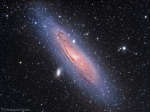 M31: The Andromeda Galaxy
27.12.2016
What is the nearest major galaxy to our own Milky Way Galaxy? Andromeda. In fact, our Galaxy is thought to look much like Andromeda. Together these two galaxies dominate the Local Group of galaxies. The diffuse light from Andromeda is caused by the hundreds of billions of stars that compose it.
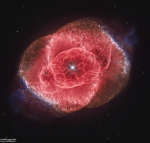 The Cats Eye Nebula from Hubble
30.01.2017
To some, it may look like a cat's eye. The alluring Cat's Eye nebula, however, lies three thousand light-years from Earth across interstellar space. A classic planetary nebula, the Cat's Eye (NGC 6543) represents a final, brief yet glorious phase in the life of a sun-like star.
 APOD: 2023 August 29 Б Unusual Spiral Galaxy M66 from Webb
29.08.2023
Why isn't spiral galaxy M66 symmetric? Usually, density waves of gas, dust, and newly formed stars circle a spiral galaxy's center and create a nearly symmetric galaxy. The differences between...
 Periodic Comet Swift Tuttle
8.08.2024
A Halley-type comet with an orbital period of about 133 years, Comet 109P/Swift-Tuttle is recognized as the parent of the annual Perseid Meteor Shower. The comet's last visit to the inner Solar System was in 1992.
|
January February March April May June July August September October |
|||||||||||||||||||||||||||||||||||||||||||||||||