
|
You entered: image
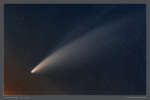 The Tails of Comet NEOWISE
11.07.2020
Comet NEOWISE (C/2020 F3) is now sweeping through northern skies. Its developing tails stretch some six degrees across this telescopic field of view, recorded from Brno, Czech Republic before daybreak on July 10. Pushed out by the pressure of sunlight itself, the comet's broad, yellowish dust tail is easiest to see.
 APOD: 2025 December 9 Б The Heart of the Soul Nebula
9.12.2025
This cosmic close-up looks deep inside the Soul Nebula. The dark and brooding dust clouds outlined by bright ridges of glowing gas are cataloged as IC 1871. About 25 light-years across, the telescopic field of view spans only a small part of the much larger Heart and Soul nebulae.
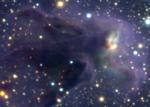 M16: Infrared Star Hunt
4.01.2002
The head of an interstellar gas and dust cloud is shown here in false-color, a near-infrared view recorded by astronomers hunting for stars within M16's Eagle Nebula. Made famous in a 1995 Hubble...
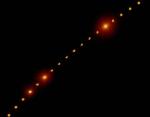 Second Millennium, Last Eclipse
5.01.2001
Christmas Day 2000 featured the final eclipse of the Second Millennium -- a partial solar eclipse visible from much of North America. Astrophotographer Phil Rau recorded the entire event on a single image as the Sun and Moon arced through winter skies above Cary, North Carolina, USA.
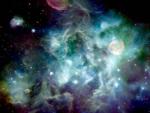 A Radio Vista of Cygnus
18.02.2002
Shells of ancient supernovas, cocoons surrounding newborn stars, and specks from distant quasars highlight this tremendous vista toward the constellation of Cygnus. The representative color image covers about 10 degrees across on the sky but is only a small part of the Canadian Galactic Plane Survey in radio light.
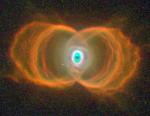 MyCn18: An Hourglass Nebula
15.06.2002
The sands of time are running out for the central star of this hourglass-shaped planetary nebula. With its nuclear fuel exhausted, this brief, spectacular, closing phase of a Sun-like star's life occurs as its outer layers are ejected - its core becoming a cooling, fading white dwarf.
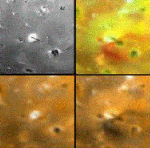 Volcano Euboea Fluctus On Io
8.09.1996
Jupiter's moon Io is turning out to be our Solar System's geologic powerhouse. The churning moon was photographed again just recently on June 27th and again shows signs of violent activity. Shown above are photographs of the volcano Euboea Fluctus taken at different times.
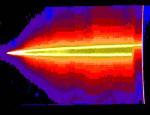 Jupiter's Ring Halo
7.08.1997
Why do small particles hover around Jupiter's rings? These particles form a previously unknown ring halo, recently discovered by the robot spacecraft Galileo currently orbiting Jupiter. Galileo obtained this image when on the far side of Jupiter - from this orientation scattered sunlight makes the halo ring visible.
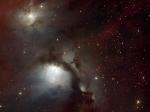 Reflection Nebulas in Orion
10.10.2006
In the vast Orion Molecular Cloud complex, several bright blue nebulas are particularly apparent. Pictured above are two of the most prominent reflection nebulas - dust clouds lit by the reflecting light of bright embedded stars. The more famous nebula is M78, near the image center, cataloged over 200 years ago.
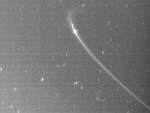 The Anthe Arc around Saturn
10.09.2008
What created this unusual partial ring around Saturn? Discovered last year, the arc was captured in clear detail only two months ago by the Saturn-orbiting Cassini spacecraft. Since the arc occupies the same orbit...
|
January February March April May June July August September |
|||||||||||||||||||||||||||||||||||||||||||||||||