
|
You entered: image
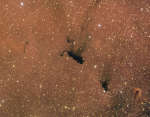 Molecular Cloud Barnard 163
1.05.2011
It may look to some like a duck, but it lays stars instead of eggs. In the center of the above image lies Barnard 163, a nebula of molecular gas and dust so thick that visible light can't shine through it.
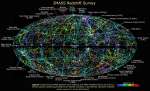 The Universe Nearby
14.06.2011
What does the universe nearby look like? This plot shows nearly 50,000 galaxies in the nearby universe detected by the Two Micron All Sky Survey (2MASS) in infrared light. The resulting image is anincredible tapestry of galaxies that provides limits on how the universe formed and evolved.
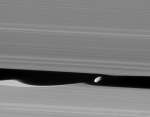 Daphnis the Wavemaker
20.01.2017
Plunging close to the outer edges of Saturn's rings, on January 16 the Cassini spacecraft captured this closest yet view of Daphnis. About 8 kilometers across and orbiting within the bright ring system's Keeler gap, the small moon is making waves.
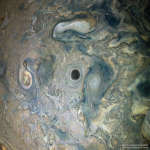 Jupiter Abyss
9.06.2019
What's that black spot on Jupiter? No one is sure. During the latest pass of NASA's Juno around Jupiter, the robotic spacecraft imaged an usually dark cloud feature informally dubbed the Abyss. Surrounding cloud patterns show the Abyss to be at the center of a vortex.
 APOD: 2024 December 11 Б The Shells and Jets of Galaxy Centaurus A
10.12.2024
What's the closest active galaxy to planet Earth? That would be Centaurus A, cataloged as NGC 5128, which is only 12 million light-years distant. Forged in a collision of two otherwise normal galaxies...
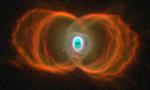 MyCn18: An Hourglass Nebula
4.06.2000
The sands of time are running out for the central star of this hourglass-shaped planetary nebula. With its nuclear fuel exhausted, this brief, spectacular, closing phase of a Sun-like star's life occurs as its outer layers are ejected - its core becoming a cooling, fading White Dwarf.
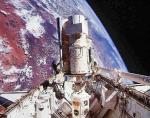 Astro 2 In Orbit
16.03.2001
Six years ago, a cluster of three ultraviolet telescopes flew into orbit on the Astro-2 mission aboard the space shuttle Endeavour. Seen here perched in Endeavour's payload bay about 350 kilometers above the Australian desert are the Hopkins Ultraviolet Telescope (HUT), the Ultraviolet Imaging Telescope (UIT), and the Wisconsin Ultraviolet Photo-Polarimeter Experiment (WUPPE).
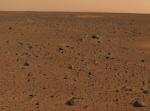 Red Mars from Spirit
6.01.2004
Rocks are strewn across the broad, flat Gusev crater floor in this sharp color picture from NASA's Spirit rover. Recorded by the rover's panoramic camera, the picture is part of Spirit's first color image of Mars - the highest resolution picture yet taken on the surface of another planet.
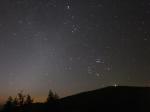 Mysterious Streaks Over Turkey
15.08.2007
What are they? Five streaks near the bottom of the above image taken near Ankara, Turkey on Sunday would be identified at first glance as meteors from the Perseids meteor shower peaking just that night. Unexpectedly, however, these streaks do not point back to the Perseids radiant in Perseus. Their origin is therefore somewhat unclear.
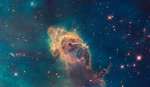 Carina Pillar and Jets
1.10.2009
This cosmic pillar of gas and dust is nearly 2 light-years wide. The structure lies within one of our galaxy's largest star forming regions, the Carina Nebula, shining in southern skies at a distance of about 7,500 light-years.
|
January February March April May June July August September |
|||||||||||||||||||||||||||||||||||||||||||||||||