
|
You entered: Earth
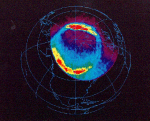 Aurora Crown the Earth
27.05.1996
What do aurora look like from space? The POLAR spacecraft answered this by photographing an auroral oval surrounding the north pole of the Earth, causing displays on both the night and day side. The auroral sub-storm, pictured in false-color above, developed within 15 minutes and may have lasted as long as on hour.
 Planet Earth at Night II
17.06.2023
Recorded during 2017, timelapse sequences from the International Space Station are compiled in this serene video of planet Earth at Night. Fans of low Earth orbit can start by enjoying the view as green and red aurora borealis slather up the sky.
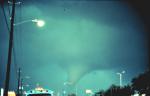 A Tornado on Planet Earth
22.07.2003
Large storms on Earth can spawn unusual, small, violent clouds known as tornadoes. Tornado clouds swirl as fast as hundreds of kilometers per second and, when they touch down, can destroy nearly everything in their long, narrow path. Many tornadoes last only a few minutes, but the largest and most dangerous can endure for hours.
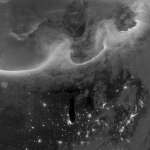 Aurorae over Planet Earth
11.10.2012
North America at night is easy to recognize in this view of our fair planet from orbit, acquired by the Suomi-NPP satellite on October 8. The spectacular waves of visible light emission rolling above the Canadian provinces of Quebec and Ontario in the upper half of the frame are the Aurora Borealis or northern lights.
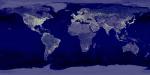 Earth at Night
22.08.2004
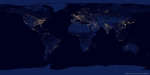
This is what the Earth looks like at night. Can you find your favorite country or city? Surprisingly, city lights make this task quite possible. Human-made lights highlight particularly developed or populated areas of the Earth's surface, including the seaboards of Europe, the eastern United States, and Japan.
 Earth at Night
9.07.2017
Can you find your favorite country or city? Surprisingly, on this world-wide nightscape, city lights make this task quite possible. Human-made lights highlight particularly developed or populated areas of the Earth's surface, including the seaboards of Europe, the eastern United States, and Japan.
 Clouds of Earth and Sky
24.07.2018
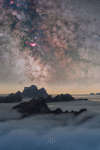
If you go high enough, you may find yourself on a picturesque perch between the water clouds of the Earth and the star clouds of the Milky Way. Such was the case last month for one adventurous alpinist astrophotographer.
 Dust Storm on Planet Earth
3.03.2000
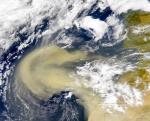
From low Earth orbit, NASA's SeaWIFS instrument records ocean color, tracking changes in our water world's climate and biosphere. But even an ocean planet can have dust storms. On February 26th, SeaWIFS...
 X-Ray Earth
16.09.2000
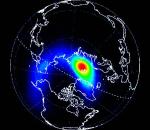
Above is a picture of the Earth in x-rays, taken in March of 1996 from the orbiting Polar satellite. Most of the planet is dark with superposed continent and coordinate grids, while the bright x-ray emission near the north pole is shown in red. Why does the Earth have an x-ray glow?
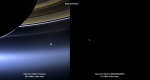 Two Views of Earth
23.07.2013
In a cross-Solar System interplanetary first, our Earth was photographed during the same day from both Mercury and Saturn. Pictured on the left, Earth is the pale blue dot just below the rings of Saturn, as captured by the robotic Cassini spacecraft now the gas giant.
|
January February March April May June July August September October |
|||||||||||||||||||||||||||||||||||||||||||||||||