
|
You entered: Earth
 A Dark Seahorse in Cepheus
7.11.2025
Spanning light-years, this suggestive shape known as the Seahorse Nebula floats in silhouette against a rich background of stars and glowing hydrogen gas. Seen toward the royal northern constellation of Cepheus, the dusty, dark nebula is part of a Milky Way molecular cloud some 1,200 light-years distant.
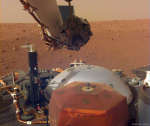 Sound and Light Captured by Mars InSight
10.12.2018
Your arm on Mars has unusual powers. For one thing it is nearly 2 meters long, has a scoop and grapple built into its hand, and has a camera built into its forearm. For another, it will soon deploy your ear -- a sensitive seismometer that will listen for distant rumblings -- onto the surface of Mars.
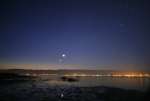 Venus and Jupiter in Morning Skies
2.02.2008
These two celestial beacons shining brightly in the east before sunrise are actually children of the Sun, the planets Venus and Jupiter. The second and third brightest objects in the sky at Night after...
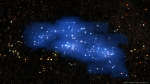 Hyperion: Largest Known Galaxy Proto Supercluster
23.10.2018
How did galaxies form in the early universe? To help find out, astronomers surveyed a patch of dark night sky with the Very Large Telescope array in Chile to find and count galaxies that formed when our universe was very young.
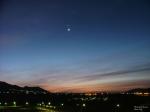 Moon Over Shiraz
13.11.2004
Early morning risers around the world have enjoyed the sight of bright planets in this week's predawn skies - further enhanced by the celestial spectacle of the waning crescent Moon. From some locations the Moon was seen to pass in front of Jupiter or Venus, a lunar occultation.
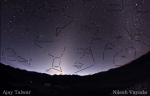 Zodiacal Light and the False Dawn
16.01.2012
Is it dawn or false dawn? During certain times of the year, the horizon near the rising Sun will begin to glow unusually early. This early glow does not originate directly from the Sun, but rather from sunlight reflected by interplanetary dust.
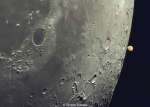 APOD: 2020 August 15 Б Mars at the Moons Edge
15.08.2020
Does the Moon ever block out Mars? Yes, the Moon occasionally moves in front of all of the Solar System's planets. Just this past Sunday, as visible from some locations in South America, a waning gibbous Moon eclipsed Mars.
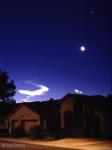 Moon, Planets, and Rocket Trails
14.07.1999
Are you an early riser? Over the last month or so, the bright planets Jupiter and Saturn have come to adorn eastern skies before sunrise. In fact, astrophotographer Joe Orman anticipated that an early...
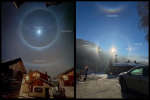 Ice Halos by Moonlight and Sunlight
9.01.2026
Both Moon and Sun create beautiful ice halos in planet Earth's sky. In fact, the two brightest celestial beacons are each surrounded by a complex of ice halos in these photos of the sky above Chamonix-Mont-Blanc in France.
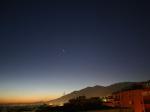 Jupiter and Venus at Sunrise
8.11.2004
What are those bright objects in the morning sky? Early morning dog walkers, among many others across our world's Northern Hemisphere, have likely noticed tremendously bright Venus hanging in the eastern sky just before sunrise. Looking a bit like an approaching airplane, Venus holds its place in the sky and never seems to land.
|
January February March April May June July August September October |
|||||||||||||||||||||||||||||||||||||||||||||||||