
|
You entered: Earth
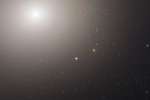 The Densest Galaxy
4.10.2013
The bright core and outer reaches of giant elliptical galaxy M60 (NGC 4649) loom large at the upper left of this sharp close-up from the Hubble Space Telescope. Some 54 million light-years away and 120,000 light-years across, M60 is one of the largest galaxies in the nearby Virgo Cluster.
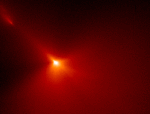 Near the Nucleus of Hyakutake
27.03.1996
NASA's Hubble Space Telescope captured this image of the near-nuclear region of Comet Hyakutake on March 25 as the comet approached within 9.3 million miles of the Earth. It covers a relatively "small" 2,000 mile wide area with the sunward direction toward the lower right (tailward is upper left).
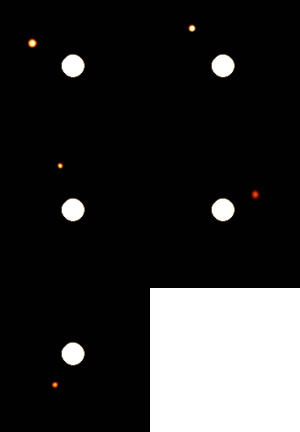 Moon Over Eugenia
14.10.1999
Eugenia is an asteroid with a moon! This animation was constructed from infrared discovery images of the Eugenia-moon system taken in November 1998 using the Canada-France-Hawaii Telescope (CFHT). Main belt asteroid Eugenia, represented here as a central white patch, is a mere 215 kilometers in diameter.
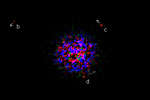 HR 8799: Discovery of a Multi planet Star System
16.11.2008
How common are planetary systems like our own Solar System? In the twelve years previous to 2008, over 300 candidate planetary systems have been found orbiting nearby stars. None, however, were directly imaged, few showed evidence for multiple planets, and many had a Jupiter-sized planet orbiting inside the orbit of Mercury.
 Neutrinos in the Sun
5.06.1998
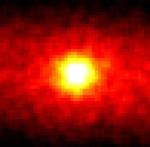
Neutrinos, along with things like electrons and quarks, are fundamental pieces of matter according to physicists' Standard Model. But neutrinos are hard to detect. Readily produced in nuclear reactions and particle collisions, they can easily pass completely through planet Earth without once interacting with any other particle.
 The Broad Tail of PanSTARRS
30.03.2013
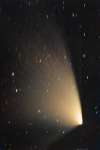
For northern hemisphere skygazers, fading Comet PanSTARRS (C/2011 L4) still hangs above the western horzion, after sunset but before moonrise in the coming days. Its perspective from planet Earth continues to reveal the comet's broad dust tail.
 M81 and Arp s Loop
8.12.2010
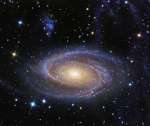
One of the brightest galaxies in planet Earth's sky and similar in size to the Milky Way, big, beautiful spiral M81 lies 11.8 million light-years away in the northern constellation Ursa Major. This...
 Comet Hale-Bopp Passes M14
11.11.1996
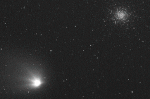
Comet Hale-Bopp continues its slow trek across the night sky, and can now be seen superposed near the bright globular cluster M14. Will Comet Hale-Bopp become as bright in early 1997 as Comet Hyakutake did in early 1996? It is still too early to tell.
 Aurora Persei
9.08.2008
Dark skies are favored for viewing meteor showers -- so the best viewing of this year's Perseids will occur in the early morning. While the Perseid meteor shower is scheduled to peak over...
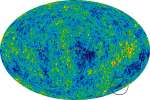 The CMB Cold Spot
20.03.2011
How could part of the early universe be so cold? No one is sure, and many astronomers now think that the CMB Cold Spot on the cosmic microwave background (CMB) radiation is not particularly noteworthy. As the early universe expanded and cooled, it suddenly and predictably became transparent.
|
January February March April May June July August September October |
|||||||||||||||||||||||||||||||||||||||||||||||||