
|
You entered: Earth
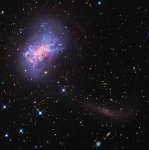 NGC 4449: Star Stream for a Dwarf Galaxy
26.01.2012
A mere 12.5 million light-years from Earth, irregular dwarf galaxy NGC 4449 lies within the confines of Canes Venatici, the constellation of the Hunting Dogs. About the size of our Milky Way's satellite...
 Passing Jupiter
26.02.2018
Here comes Jupiter! NASA's robotic spacecraft Juno is continuing on its 53-day, highly-elongated orbits around our Solar System's largest planet. The featured video is from perijove 11, the eleventh time Juno has passed near Jupiter since it arrived in mid-2016.
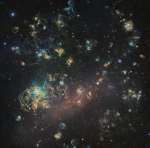 Clouds of the Large Magellanic Cloud
3.05.2019
The Large Magellanic Cloud (LMC) is an alluring sight in southern skies. But this deep and detailed telescopic view, over 10 months in the making, goes beyond what is visible to most circumnavigators of planet Earth.
 Hubble s Andromeda Galaxy Mosaic
21.02.2025
The largest photomosaic ever assembled from Hubble Space Telescope image data is a panoramic view of our neighboring spiral Andromeda Galaxy. With 600 overlapping frames assembled from observations made from July 2010 to December 2022, the full Hubble Andromeda Galaxy mosaic spans almost six full moons across planet Earth's sky.
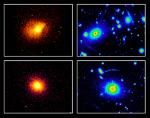 The Matter of Galaxy Clusters
24.10.2001
Situated over 2,000,000,000 (two billion) light-years from Earth, galaxies in cluster Abell 2390 (top) and MS2137.3-2353 (bottom) are seen in the right hand panels above, false-color images from the Hubble Space Telescope. Corresponding panels on the left reveal each cluster's x-ray appearance in images from the Chandra X-ray Observatory.
 APOD: 2025 July 17 Б 3I/ATLAS
17.07.2025
Discovered on July 1 with the NASA-funded ATLAS (Asteroid Terrestrial-impact Last Alert, System) survey telescope in Rio Hurtado, Chile, 3I/ATLAS is so designated as the third known interstellar object to pass through our Solar System It follows 1I/йOumuamua in 2017 and the comet 2I/Borisov in 2019.
 In the Glare of Alpha Centauri
28.06.2012
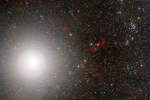
The glare of Alpha Centauri, one of the brightest stars in planet Earth's night sky, floods the left side of this southern skyscape. A mere 4.3 light-years distant, Alpha Centauri actually consists of two component stars similar in size to the Sun, locked in a mutual orbit.
 Small Star
20.11.1999
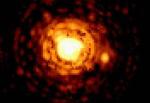
A dim double star system cataloged as Gliese 623 lies 25 light-years from Earth, in the constellation of Hercules. The individual stars of this binary system were distinguished for the first time when the Hubble Space Telescope's Faint Object Camera recorded this image in June 1994.
 R Leporis: A Vampire's Star
31.10.2018
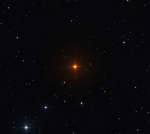
Better known as Hind's Crimson Star, R Leporis is a rare star in planet Earth's night sky. It's also a shocking shade of red. The star's discoverer, 19th century English...
 First Horizon Scale Image of a Black Hole
1.05.2022
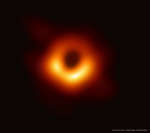
What does a black hole look like? To find out, radio telescopes from around the Earth coordinated observations of black holes with the largest known event horizons on the sky. Alone, black holes are just black, but these monster attractors are known to be surrounded by glowing gas.
|
January February March April May June July August September October |
|||||||||||||||||||||||||||||||||||||||||||||||||