
|
You entered: light
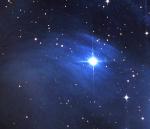 Reflection Nebula NGC 1435
1.03.1999
Reflection nebulae reflect light from a nearby star. Many small carbon grains in the nebula reflect the light. The blue color typical of reflection nebula is caused by blue light being more efficiently scattered by the carbon dust than red light.
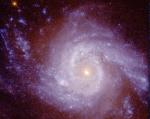 Spiral Galaxy NGC 3310 in Ultraviolet
17.01.2001
Why is NGC 3310 bursting with young stars? The brightest of these new stars are so hot that they light up this spiral galaxy not only in blue light, but in light so blue humans can't see it: ultraviolet. The Hubble Space Telescope took the above photograph in different bands of ultraviolet light.
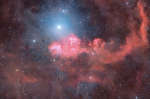 Ghosts in Cassiopeia
31.10.2025
Halloween is an astronomy holiday and spooky shapes always seem to lurk in planet Earth's night skies. In fact, near the center of this telescopic view toward the constellation Cassiopeia these swept-back interstellar clouds IC 59 (left) and IC 63 look ghostly on a cosmic scale.
 A Dark Seahorse in Cepheus
7.11.2025
Spanning light-years, this suggestive shape known as the Seahorse Nebula floats in silhouette against a rich background of stars and glowing hydrogen gas. Seen toward the royal northern constellation of Cepheus, the dusty, dark nebula is part of a Milky Way molecular cloud some 1,200 light-years distant.
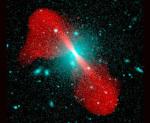 Jets from Radio Galaxy 3C296
26.02.2002
Jets of streaming plasma expelled by the central black hole of a massive elliptical galaxy likely light up this composite image of 3C296. The jets emanating from NGC 5532 and are nearly a million light years long. Exactly how the central black hole expels the infalling matter is still unknown.
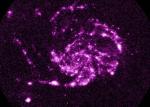 M101: An Ultraviolet View
8.06.1997
This giant spiral galaxy, Messier 101 (M101), was photographed by the Ultraviolet Imaging Telescope (UIT). UIT flew into orbit as part of the Astro 2 mission on-board the Space Shuttle Endeavour in March 1995. The image has been processed so that the colors (purple to white) represent an increasing intensity of ultraviolet light.
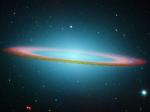 The Sombrero Galaxy in Infrared
21.01.2007
This floating ring is the size of a galaxy. In fact, it is part of the photogenic Sombrero Galaxy, one of the largest galaxies in the nearby Virgo Cluster of Galaxies. The dark band of dust that obscures the mid-section of the Sombrero Galaxy in optical light actually glows brightly in infrared light.
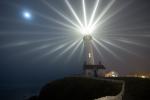 Moon Over Pigeon Point Lighthouse
26.11.2007
This spectacular sky is mostly human-made. Once a year, the Light Station at Pigeon Point near San Francisco, California, USA is lit as it was over 100 years ago. During this time, light generated by five kerosene lamps pours through 24 rotating Fresnel lenses, warning approaching ships to stay away.
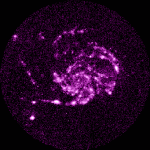 An Ultraviolet Image of M101
27.06.1995
This giant spiral galaxy, Messier 101 (M101), was photographed by the Ultraviolet Imaging Telescope onboard the Space Shuttle Endeavour during the Astro-2 mission (March 2 - 18, 1995). The image has been computer processed so that the colors represent the intensity of ultraviolet light.
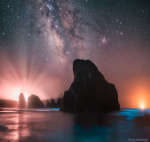 Sea and Sky Glows over the Oregon Coast
28.08.2018
Every step caused the sand to light up blue. That glow was bioluminescence -- a blue radiance that also lights the surf in this surreal scene captured last month at Meyer's Creek Beach in Oregon, USA. Volcanic stacks dot the foreground sea, while a thin fog layer scatters light on the horizon.
|
January February March April May June July August September October |
|||||||||||||||||||||||||||||||||||||||||||||||||