
|
You entered: light
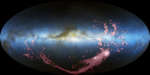 The Magellanic Stream
25.01.2010
Spanning the sky toward the majestic Clouds of Magellan is an unusual stream of gas: the Magellanic Stream. The origin of this gas remains unknown but likely hold a clue to origin and fate of our Milky Way's most famous satellite galaxies: the LMC and the SMC.
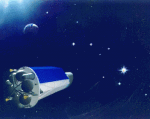 Searching For Solar Systems
15.11.1996
Observational astronomy has recently provided evidence of the existence of massive Jupiter-sized planets orbiting distant suns, protoplanetary disks of gas and dust surrounding newly formed stars, and planetary bodies orbiting exotic stellar corpses known as pulsars. Indeed, the formation of planets seems to be a broader and more varied phenomenon than previously imagined.
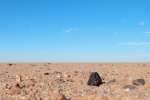 Almahata Sitta 15
28.03.2009
Small asteroid 2008 TC3 fell to Earth at dawn on October 7, 2008, tracking through the skies over the Nubian Desert in northern Sudan. That event was remarkable because it was the first time an asteroid was detected in space before crashing into planet Earth's atmosphere.
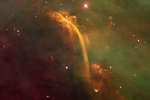 HH 222: The Waterfall Nebula
24.10.2011
What created the Waterfall Nebula? No one knows. The structure seen in the region of NGC 1999 in the Great Orion Molecular Cloud complex is one of the more mysterious structures yet found on the sky. Designated HH-222, the elongated gaseous stream stretches about ten light years and emits an unusual array of colors.
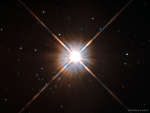 Proxima Centauri: The Closest Star
18.01.2016
Does the closest star to our Sun have planets? No one is sure -- but you can now follow frequent updates of a new search that is taking place during the first few months of this year. The closest star, Proxima Centauri, is the nearest member of the Alpha Centauri star system.
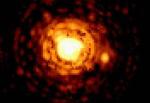 Small Star
20.11.1999
A dim double star system cataloged as Gliese 623 lies 25 light-years from Earth, in the constellation of Hercules. The individual stars of this binary system were distinguished for the first time when the Hubble Space Telescope's Faint Object Camera recorded this image in June 1994.
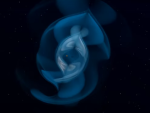 GW200115: Simulation of a Black Hole Merging with a Neutron Star
14.07.2021
What happens when a black hole destroys a neutron star? Analyses indicate that just such an event created gravitational wave event GW200115, detected in 2020 January by LIGO and Virgo observatories. To better understand the unusual event, the featured visualization was created from a computer simulation.
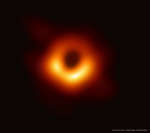 First Horizon Scale Image of a Black Hole
1.05.2022
What does a black hole look like? To find out, radio telescopes from around the Earth coordinated observations of black holes with the largest known event horizons on the sky. Alone, black holes are just black, but these monster attractors are known to be surrounded by glowing gas.
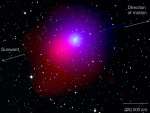 The Swift View of Comet Lulin
21.02.2009
Now growing brighter, Comet Lulin is headed for its closest approach to planet Earth early next week. But the comet's greenish glow, familiar to earthbound skygazers, is replaced by false colors in this premier view from the orbiting Swift satellite.
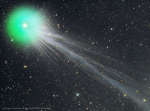 The Complex Ion Tail of Comet Lovejoy
20.01.2015
What causes the structure in Comet Lovejoy's tail? Comet C/2014 Q2 (Lovejoy), which is currently at naked-eye brightness and near its brightest, has been showing an exquisitely detailed ion tail. As the name...
|
January February March April May June July August September October |
|||||||||||||||||||||||||||||||||||||||||||||||||