
|
You entered: light
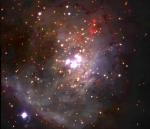 Free Floating Planets In Orion
31.03.2000
This false-colour image of the young Trapezium star cluster in the Orion Nebula was made with an infrared camera at wavelengths about twice as long as visible light. The infrared data are part...
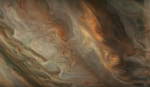 Perijove 16: Passing Jupiter
5.02.2019
Watch Juno zoom past Jupiter again. NASA's robotic spacecraft Juno is continuing on its 53-day, highly-elongated orbits around our Solar System's largest planet. The featured video is from perijove 16, the sixteenth time that Juno has passed near Jupiter since it arrived in mid-2016.
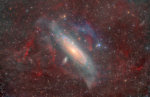 APOD: 2026 June 3 Б Andromeda Through Gas and Dust
3.06.2026
Over 1000 years ago, Persian astronomer Abd al-Rahman al-Sufi published humanityБs oldest known record of the Andromeda Galaxy in "The Book of Fixed Stars" (Bodleian Library MS. Marsh 144 p. 167). 800 years later, Andromeda became the 31st entry in Charles MessierБs "Catalogue of Nebulae and Star Clusters".
 APOD: 2024 April 21 Б Perijove 16: Passing Jupiter
21.04.2024
Watch Juno zoom past Jupiter. NASA's robotic spacecraft Juno is continuing on its now month-long, highly-elongated orbits around our Solar System's largest planet. The featured video is from perijove 16, the sixteenth time that Juno passed near Jupiter since it arrived in mid-2016.
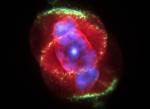 X-rays From The Cat's Eye
11.01.2001
Haunting patterns within planetary nebula NGC 6543 readily suggest its popular moniker -- the Cat's Eye nebula. In 1995, a stunning false-color optical image from the Hubble Space Telescope detailed the swirls of this glowing nebula, known to be the gaseous shroud expelled from a dying sun-like star about 3,000 light-years from Earth.
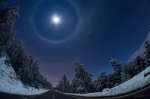 A Quadruple Lunar Halo Over Spain
3.12.2012
Sometimes falling ice crystals make the atmosphere into a giant lens causing arcs and halos to appear around the Sun or Moon. This past Saturday night was just such a time near Madrid, Spain, where a winter sky displayed not only a bright Moon but as many as four rare lunar halos.
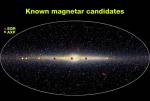 Magnetars In The Sky
1.09.2001
Indicated on this infrared image of the galactic center region are positions of candidate magnetars -- believed to be the strongest magnets in the galaxy. Classified by observers as Soft Gamma Repeaters (SGRs) and Anomalous X-ray Pulsars (AXPs), these cosmic powerhouses are likely city-sized, spinning, highly-magnetized neutron stars. How strong is a magnetar's magnetic field?
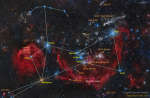 Official Star Names for Orion
4.12.2016
Familiar stars in Orion and constellations across the sky now have official names. Over the past year, the International Astronomical Union, the only body officially tasked with naming stars, approved names already in common use for 227 of the brightest stars, including the most famous stars on the sky Sirius, Polaris, and Betelgeuse.
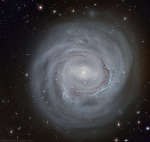 Anemic Spiral NGC 4921 from Hubble
15.05.2019
How far away is spiral galaxy NGC 4921? It's surpringly important to know. Although presently estimated to be about 300 million light years distant, a more precise determination could be coupled with its known recession speed to help humanity better calibrate the expansion rate of the entire visible universe.
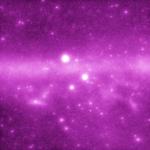 GLAST Gamma Ray Sky Simulation
22.07.2000
What shines in the gamma-ray sky? This simulated image models the intensities of gamma rays with over 40 million times the energy of visible light, and represents how the sky might appear to the Gamma-ray Large Area Space Telescope (GLAST) after its first year in orbit.
|
January February March April May June July August September October |
|||||||||||||||||||||||||||||||||||||||||||||||||