
|
You entered: light
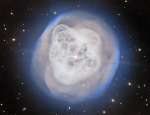 APOD: 2026 May 28 Б NGC 1514: The Crystal Ball Nebula
28.05.2026
What do you see in this crystal ball? The featured image shows NGC 1514, known as the Crystal Ball Nebula, observed by the Gemini North telescope on Maunakea, in Hawai'i. NGC 1514 is 1,500 light-years away and was discovered by William Herschel in 1790.
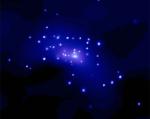 NGC 4697: X Rays from an Elliptical Galaxy
17.06.2002
The many bright, point-like sources in this Chandra Observatory x-ray image lie within NGC 4697, an elliptical galaxy some 40 million light-years away towards Virgo. Like other normal elliptical galaxies, NGC 4697 is a spherical ensemble of mainly older, fainter, low mass stars, with little star forming gas and dust compared to spiral galaxies.
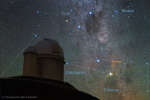 Closest Star has Potentially Habitable Planet
25.08.2016
The star closest to the Sun has a planet similar to the Earth. As announced yesterday, recent observations confirmed that this planet not only exists but inhabits a zone where its surface temperature could allow liquid water, a key ingredient for life on Earth.
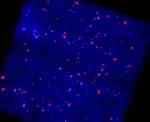 X-Rays from the Galactic Plane
14.08.2001
In February 2000, the orbiting Chandra X-ray Observatory spent 27 hours staring into the plane of our Milky Way galaxy. Its target was a spot in the small constellation Scutum, within the Milky Way's zone of avoidance where galactic gas and dust clouds block visible light, making a poor window for optical telescopes.
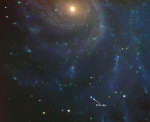 A Young Supernova in the Nearby Pinwheel Galaxy
26.08.2011
A nearby star has exploded and telescopes all over the world are turning to monitor it. The supernova, dubbed PTF 11kly, was discovered by computer only two days ago as part of the Palomar Transit Factory (PTF) sky survey utilizing the wide angle 1.2-meter Samuel Oschwin Telescope in California.
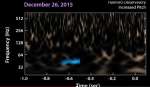 GW151226: A Second Confirmed Source of Gravitational Radiation
15.06.2016
A new sky is becoming visible. When you look up, you see the sky as it appears in light -- electromagnetic radiation. But just over the past year, humanity has begun to see our once-familiar sky as it appears in a different type of radiation -- gravitational radiation.
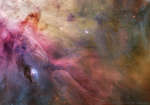 LL Ori and the Orion Nebula
18.02.2018
Stars can make waves in the Orion Nebula's sea of gas and dust. This esthetic close-up of cosmic clouds and stellar winds features LL Orionis, interacting with the Orion Nebula flow. Adrift...
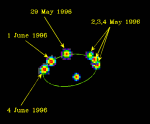 Mizar Binary Star
19.02.1997
Mizar (sounds like "My Czar") is a binary star. In fact, most stars are binary stars. In a binary star system, each star of the pair follows an elliptical orbital path. Mutual gravity causes...
 SN 2006GY: Brightest Supernova
10.05.2007
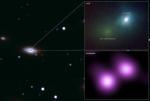
The stellar explosion cataloged as supernova SN 2006gy shines in this wide-field image (left) of its host galaxy, NGC 1260, and expanded view (upper right panel) of the region surrounding the galaxy's core.
 Layers of a Total Solar Eclipse
27.09.2017
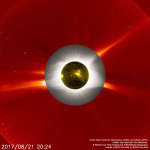
Neither rain, nor snow, nor dark of night can keep a space-based spacecraft from watching the Sun. In fact, from its vantage point 1.5 million kilometers sunward of planet Earth, NASA's SOlar Heliospheric Observatory (SOHO) can always monitor the Sun's outer atmosphere, or corona.
|
January February March April May June July August September October |
|||||||||||||||||||||||||||||||||||||||||||||||||