
|
You entered: light
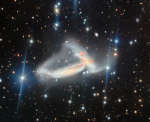 APOD: 2026 September 4 Б Na Uhane Mahoe Huki Pu i ke Ola
4.09.2026
Nд йUhane Mдhoe Huki Pе i ke Ola, is the Hawaiian name given to this image of a pair of spiral galaxies locked in a mutual gravitational embrace. Some 200 million light-years distant toward...
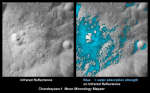 Water Discovered on the Moon
28.09.2009
Water has been discovered on the surface of the Moon. No lakes have been found, but rather NASA's Moon Mineralogy Mapper aboard India's new Chandrayaan-1 lunar orbiter radios back that parts of the Moon's surface absorb a very specific color of light identified previously only with water.
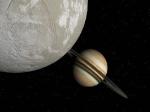 Worlds of a Distant Sun: 47 Ursae Majoris b
5.10.1997
In the last few years, observational astronomy has given humanity evidence of the existence of worlds beyond the solar system. Solar-type stars are now inferred to harbor planets of approximately Jupiter mass - some residing in temperature zones which could conceivably support liquid water and therefore life!
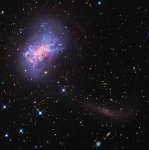 NGC 4449: Star Stream for a Dwarf Galaxy
26.01.2012
A mere 12.5 million light-years from Earth, irregular dwarf galaxy NGC 4449 lies within the confines of Canes Venatici, the constellation of the Hunting Dogs. About the size of our Milky Way's satellite...
 The Porpoise Galaxy from Hubble
24.06.2013
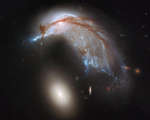
What's happening to this spiral galaxy? Just a few hundred million years ago, NGC 2936, the upper of the two large galaxies shown, was likely a normal spiral galaxy -- spinning, creating stars -- and minding its own business.
 Ice Ring around Nearby Star Fomalhaut
3.10.2017
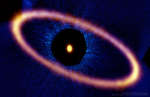
Why is there a large ice ring around Fomalhaut? This interesting star -- easily visible in the night sky -- lies only about 25 light-years away and is known to be orbited by at least one planet, Dagon, as well as several inner dust disks.
 Passing Jupiter
26.02.2018
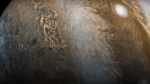
Here comes Jupiter! NASA's robotic spacecraft Juno is continuing on its 53-day, highly-elongated orbits around our Solar System's largest planet. The featured video is from perijove 11, the eleventh time Juno has passed near Jupiter since it arrived in mid-2016.
 Comet Tsuchinshan ATLAS Flys Away
19.10.2024
These six panels follow daily apparitions of comet C/2023 A3 Tsuchinshan-ATLAS as it moved away from our fair planet during the past week. The images were taken with the same camera and lens at the indicated dates and locations from California, planet Earth.
 Hubble s Andromeda Galaxy Mosaic
21.02.2025
The largest photomosaic ever assembled from Hubble Space Telescope image data is a panoramic view of our neighboring spiral Andromeda Galaxy. With 600 overlapping frames assembled from observations made from July 2010 to December 2022, the full Hubble Andromeda Galaxy mosaic spans almost six full moons across planet Earth's sky.
 The Matter of Galaxy Clusters
24.10.2001
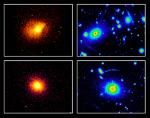
Situated over 2,000,000,000 (two billion) light-years from Earth, galaxies in cluster Abell 2390 (top) and MS2137.3-2353 (bottom) are seen in the right hand panels above, false-color images from the Hubble Space Telescope. Corresponding panels on the left reveal each cluster's x-ray appearance in images from the Chandra X-ray Observatory.
|
January February March April May June July August September October |
|||||||||||||||||||||||||||||||||||||||||||||||||