
|
You entered: light
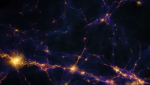 Galaxy Formation in a Magnetic Universe
19.02.2018
How did we get here? We know that we live on a planet orbiting a star orbiting a galaxy, but how did all of this form? To understand details better, astrophysicists upgraded the famous Illustris Simulation into IllustrisTNG -- now the most sophisticated computer model of how galaxies evolved in our universe.
 APOD: 2025 May 11 Б The Surface of Venus from Venera 14
11.05.2025
If you could stand on Venus -- what would you see? Pictured is the view from Venera 14, a robotic Soviet lander which parachuted and air-braked down through the thick Venusian atmosphere in March of 1982.
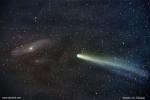 A Galaxy is not a Comet
12.04.2002
This gorgeous galaxy and comet portrait was recorded on April 5th in the skies over the Oriental Pyrenees near Figueres, Spain. From a site above 1,100 meters, astrophotographer Juan Carlos Casado used...
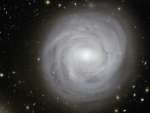 Anemic Galaxy NGC 4921 at the Edge
9.02.2009
How far away is spiral galaxy NGC 4921? Although presently estimated to be about 320 million light years distant, a more precise determination could be coupled with its known recession speed to help humanity better calibrate the expansion rate of the entire visible universe.
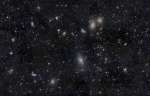 Virgo Cluster Galaxies
22.04.2011
Well over a thousand galaxies are known members of the Virgo Cluster, the closest large cluster of galaxies to our own local group. In fact, the galaxy cluster is difficult to appreciate all at once because it covers such a large area on the sky.
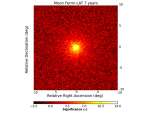 Fermi s Gamma-ray Moon
29.04.2016
If you could only see gamma-rays, photons with up to a billion or more times the energy of visible light, the Moon would be brighter than the Sun! That startling notion underlies this novel...
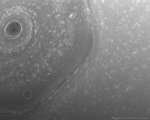 Over Saturns Turbulent North Pole
12.12.2016
The Cassini spacecraft's Grand Finale at Saturn has begun. The Grand Finale will allow Cassini to explore Saturn and some of Saturn's moons and rings in unprecedented detail. The first phase started...
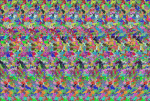 The Holographic Principle
30.01.2005
Is this image worth a thousand words? According to the Holographic Principle, the most information you can get from this image is about 3 x 10 65 bits for a normal sized computer monitor.
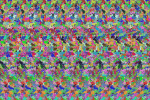 The Holographic Principle
13.09.2009
Is this picture worth a thousand words? According to the Holographic Principle, the most information you can get from this image is about 3 x 10 65 bits for a normal sized computer monitor.
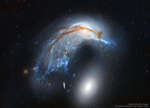 The Porpoise Galaxy from Hubble
6.02.2017
What's happening to this spiral galaxy? Just a few hundred million years ago, NGC 2936, the upper of the two large galaxies shown, was likely a normal spiral galaxy -- spinning, creating stars -- and minding its own business.
|
January February March April May June July August September October |
|||||||||||||||||||||||||||||||||||||||||||||||||