
|
You entered: light
 APOD: 2024 March 25 Б Sonified: The Jellyfish Nebula Supernova Remnant
25.03.2024
What does a supernova remnant sound like? Although sound is a compression wave in matter and does not carry into empty space, interpretive sound can help listeners appreciate and understand a visual image of a supernova remnant in a new way. Recently, the Jellyfish Nebula (IC 443) has been sonified quite creatively.
 The Holographic Principle
18.05.2003
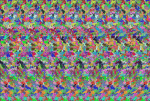
Is this image worth a thousand words? According to the Holographic Principle, the most information you can get from this image is about 3 x 1065 bits for a normal sized computer monitor.
 Small Star
5.06.1997
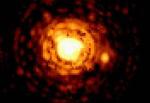
A dim double star system cataloged as Gliese 623 lies 25 light-years from Earth, in the constellation of Hercules. The individual stars of this binary system were distinguished for the first time when the Hubble Space Telescope's Faint Object Camera recorded this image in June 1994.
 Recurrent Nova RS Ophiuci
24.02.2006
This pretty star field in the constellation Ophiucus is centered on a star not often seen - RS Ophiuci. In fact, early last week RS Oph suddenly became visible to the naked eye for the first time since 1985.
 Gamma Ray Bursting
4.11.1999
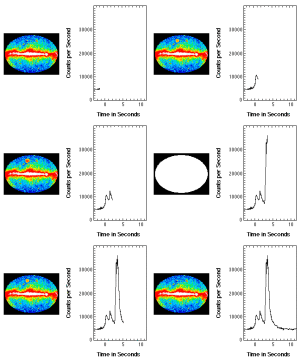
Using graphics and data from NASA's Compton Gamma Ray Observatory, this animation illustrates one of the most exciting mysteries of modern astrophysics, gamma-ray bursts. Incredibly gamma-ray bursts, sudden flashes of radiation with over 100,000 times the energy of visible light photons, occur several times a day.
 The Fainting of Betelgeuse
2.01.2020
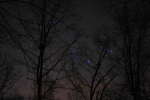
Begirt with many a blazing star, Orion the Hunter is one of the most recognizable constellations. In this night skyscape the Hunter's stars rise in the northern hemisphere's winter sky on December 30, 2019, tangled in bare trees near Newnan, Georgia, USA.
 Perijove 11: Passing Jupiter
28.08.2022
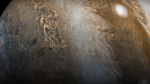
Here comes Jupiter! NASA's robotic spacecraft Juno is continuing on its highly-elongated orbits around our Solar System's largest planet. The featured video is from perijove 11 in early 2018, the eleventh time Juno has passed near Jupiter since it arrived in mid-2016.
 Gamma Ray Moon
17.04.1999
What if you could see gamma rays (photons with more than 40 million times the energy of visible light)? If you could, the Moon would appear brighter than the Sun! This startling notion...
 An Unexpected Flare from the Crab Nebula
23.05.2011
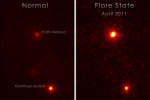
Why does the Crab Nebula flare? No one is sure. The unusual behavior, discovered over the past few years, seems only to occur in very high energy light -- gamma rays. As recently...
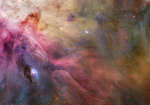 LL Ori and the Orion Nebula
3.02.2013
This esthetic close-up of cosmic clouds and stellar winds features LL Orionis, interacting with the Orion Nebula flow. Adrift in Orion's stellar nursery and still in its formative years, variable star LL Orionis produces a wind more energetic than the wind from our own middle-aged Sun.
|
January February March April May June July August September October |
|||||||||||||||||||||||||||||||||||||||||||||||||